130 kilometers north of Prague, the town known as Karlsbad was already famous in the 19th century for its numerous hot springs. Today it is part of the Czech Republic. Its original name is Karlovy Vary and it has turned into a spa town that every summer receives the visit of many celebrities.
It was there where, for three weeks in August and September 1835, Chopin was with his parents for the last time. Frédéric traveled from Paris and his parents from Warsaw, to meet again after a separation of five years.
A recent biographer of Frédéric tells us that they arrived almost simultaneously in mid-August, staying at the hotel The Golden Rose, where they were received by some old friends, Polish exiles living in the area, with whom they will spend time until September 6 when they traveled to Teplitz for a few days to then visit the counts Thun-Hohenstein in his castle, from where finally Nicholas Chopin and Justina will leave for Warsaw on the 14th of that month. Frédéric will stay one more week with the Thun-Hohenstein, before returning to Paris, where he had been living since 1831.
The biographer points out that in those three weeks Frédéric composed a mazurka, the waltz opus 34 N° 1 and the Polonaise N° 1 from Opus 26. (We heard the latter in the rendition by the Ukrainian pianist Valentina Lisitsa).
Our biographer also points out that during those three weeks, in addition to composing, Frédéric livened up the evenings by playing the piano for his parents and friends. At this point, Dorie, a great friend of this blog has raised a disturbing question: on what piano did Chopin compose and play during that stay?
It is natural to assume that the works may have been created in the house of the Polish friends, perhaps in Teplitz, in the Hohenstein castle, who knows. It may be, says my friend, skeptical. I want to believe, she continues, that if today many hotels admit a piano in the lobby it is because an old tradition so dictates. The hotel The Golden Rose was a pioneer, she says: the upright piano, somewhat out of tune, was in a small and rustic dining room adjoining the reception room. On that piano, Frédéric improvised in the mornings, and in the evenings he played for those who were present there.
Fortunate circumstance – my friend finished off –, that of those guests who happened to meet Chopin in those days and who, during the dinner, could hear pieces of virgin music emerged from the hands of a pale and thin youth, who after playing, smiled at them as if he had not done anything to write home about.
In 1735, the year of publication of his Italian Concerto, Johann Sebastián Bach was fifty years old and had been living in full happiness for fourteen years with his second wife, Anna Magdalena, who at the time was 34. The large family (that year was born Johann Christian Bach, the eleventh son of Bach, and who will be a composer of the first order) was settled since 1723 in Leipzig, where Johann Sebastian was working as the Kantor (a position of lower category than that of maestro di capella) of the Saint Thomas church.
The tasks he had to fulfil there were: teaching music, Latin, and Luther's catechism to the students of the Tomasschulle, besides composing music and conducting it in Saint Thomas and Saint Nicholas churches. The family would live with ease because –like the rest of the teachers– they had free accommodation in the Tomasschulle and, as will be usual in his professional life, Bach was very well paid.
The Italian Concerto is the first part of his second keyboard exercise book, Klavierübung II. The notebook is entitled: "Second part of the practice of the harpsichord, consisting of a concert according to Italian taste and an overture according to the French way, for a harpsichord of two manual keyboards, prepared to recreate the spirit of the fans, by JS Bach...". The "Italian way" of the concert refers, according to scholars, to the alternation of playing piano and forte on the two keyboards.
The concerto is in three brief movements. We are listening to the first one, in the rendering by the pianist Umi Garret, who at the time of this performance was seven years old. The video ends inviting us to listen to the second movement, where Umi needs just two or three bars to show great musicality. Thanks to Umi and a long series of pianists under the age of eight, the parents who, once proud, were harassing us with the story that their six-year-old son "learned to play 'Jingle Bells' on his keyboard for Christmas", have been eradicated forever from the face of the earth.
The recently deceased pianist Jacques Loussier, a French musician who knew how to combine jazz with baroque music, gives us the following jazz version of the Italian Concerto of JS Bach, in a performance from the year 1988. Loussier, in his last recordings with his jazz group Play Bach Trio, brought in music from Debussy, Satie, Ravel, Chopin and even Mozart.
Dear visitor, if you liked the article, we will be grateful if you share it, on Facebook, or Twitter, with an easy click
Although before the formal premiere Beethoven had made known the Concerto No. 1 in C major in Vienna before small audiences formed by his noble friends, the truth is that its world premiere took place in Prague in 1798.
The Concerto No 1 is not the first composed by Beethoven. It was preceded by Concerto No 2 and a sketch of another in E flat, which has nothing to do with the Emperor Concerto. Composed in 1797 – Beethoven has been established in Vienna for four years –, the first official performance of the concerto before the Viennese audience occurred only in April 1800, on a Friday afternoon, with a young Ludwig thirty-year-old as soloist and conductor. The program included the First Symphony (on premiere) and the Septimino, as well as a Mozart symphony and selections from the oratorio The Creation, by Haydn.
The Concerto is in three parts, in the common classic style:
–Allegro con brío
–Largo
–Allegro scherzando
First movement - Allegro con brio
The first movement begins with a long introduction of the orchestra presenting two themes, agile and spirited the first, which at minute 1:30 gives way to a second one, a more lyrical theme.
The cadenza, that is, that section destined for the soloist to show his virtuosity or abilities for improvisation, seems to be, in this case, what Beethoven himself wrote.
The rendition is by Krystian Zimerman, at the piano and conducting.
Second movement - Largo Largo is the tempo indication that Beethoven pointed out for the second movement. Largo literally means "broad" and indicates that the piece should be played very slowly.
The tempo indications in music, whose purpose is to indicate the speed at which the piece should be played, began to be used extensively from the seventeenth century on, a period during which a significant number of great composers were coming from regions that in the 19th century are going to constitute the Italian nation, for that reason the words used for such purpose are written in the language of that nation, Italian.
Obviously, the same reasons apply to the origin of dynamic indications: forte, piano; or for the so-called "agogics": accelerando, diminuendo (alterations of, precisely, the tempo) and, in general, for all kinds of indications in the score.
But as a single word can have hundreds of meanings and resonances for different individuals, already before 1800 it had become necessary the invention of a mechanical device with whose help the speed at which a piece should be executed could be established unambiguously. After several attempts with varying degrees of success or failure, the metronome saw its definitive concretion – until today – in the device patented by J. Nepomuk Mälzel in 1815. And the first composer in incorporating metronomic indications to his scores was the very same Ludwig van Beethoven.
As romantic as it could be, the maestro was not able to resist the temptation to try this new conquest of human ingenuity. The man had reached the metronome, and Ludwig was not indifferent to it.
However, the device did not replace by far the tempo indications written by the composer in his own handwriting. (Nor was that his goal). The metronome is limited to indicating a number of quarter notes or eighths per minute, mathematically. Words, on the other hand, add to the indicated speed an atmosphere, a certain spirit or even a state of mind with which the work must be approached. That conjunction of speed and atmosphere is what we believe constitutes the tempo of the work.
The rendition is by the Italian maestro Pietro Papagna accompanied by the Citta di Fondi Chamber Orchestra conducted by Ertug Korkmaz.
By that time, the Viennese had already warned that the maestro Beethoven was much more than a professional and prominent pianist. However, it is not easy to say that his contemporaries saw in Beethoven the genius known to us. To the Viennese people of 1800, the music of Beethoven may have even seemed a bit snobby: his music was too unique. "The spectators come to my concerts to mourn like the readers of a saga," he said. Neither were absent less encouraging reviews. In 1796, during a tour of several countries, a Prague music critic wrote: "it struck our ears but not our hearts". In Berlin, during the same tour, even though the monarch Frederick William II of Prussia entertained him with a box full of gleaming "louises", nor did he find the ideal audience there. "I played the best I could," he declared bitterly years later, "and I expected great success. But it did not sound like a round of applause! The audience had moved to mourn, soaking their handkerchiefs to show their gratitude. I remained completely indifferent, I understood that it was a corny auditorium, but not fond of art ".
And on the occasion of the April 1800 concert, the Allgemeine Musikalische Zeitung magazine said that the concert had been "the most interesting one heard in a long time" but at the same time observed that "the musicians of the orchestra did not bother to pay much attention to the soloist". The soloist was, of course, Beethoven.
Rondo - Allegro scherzando
The third movement of the concerto is a rondo, a musical form based on the repetition of the main theme that alternates with other secondary ones. Its tempo indication is Allegro scherzando, something like fast but playful. The solo piano introduces the first theme, then the orchestra will follow.
The pianist ends his task without fuss, at 8:49, when at the end of a sweet section he must play a D and then a C, pianissimo. Precisely this last one failed once Martha Argerich, the key did not make a sound and she just looked at the conductor with an expression on her face that was telling "ok, so be it". After that, whether or not it sounds, the orchestra intervenes with a short and placid phrase, to then attack with bravery the closing of the work.
The rendition is by Vladimir Ashkenazy accompanied by the London Philharmonic Orchestra conducted by Bernard Haitink.
Dear visitor, if you liked the article, we will be grateful if you share it, on Facebook, or Twitter, with an easy click
Gioacchino Antonio Rossini was fourteen years old when he composed his first opera, the year 1806. For a time he doubted where to turn his vocation as a musician but, fortunately, he lived in a time when opera, and especially opera buffa, had become an authentic passion for the Italian people, a passion that also reached all social classes. Therefore, Rossini didn't require too much thinking about making a decision.
In those years the operatic genre lived an intense life, to the point that it was not uncommon for composers to be distressed by the urgent delivery of the next opera, even though they received a relatively modest amount of money for their work. New shows every season, was the demand of the audience of the time, and it was a need pleasing it.
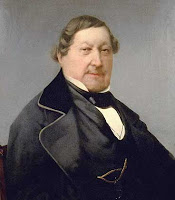
Gioacchino Rossini (1792 - 1868)
L'Italiana in Algeri (The Italian Girl in Algiers)
Thus, while the performances of his acclaimed opera Tancredi, of 1813 (his first serious opera, however) were still on stage, Rossini began working on a quite lengthy farce, although it only was in two acts, as was customary.
The text of L'Italiana in Algeri had already been put on music before, but with no much success. Rossini will be responsible for its transformation into a masterpiece, as his absurd and to some extent, grotesque situations, were fitting like a glove to the comic vein of maestro Gioacchino. (Il Barbiere and La Cenerentolawill be coming later).
Released on May 22, 1813, L'Italiana in Algeri is a classic opera with a "Muslim" theme, as The Abduction from the Seraglio, by Mozart, was years before. The scene is set in the palace of the Bey of Algiers (the lord and master during the Ottoman Empire), Mustafa, an autocrat of unstoppable vocation for the female company who happens to be somewhat tired of his current wife and wants to change her for another, if Italian, better. It so happens that Isabella, an Italian, walks the coast of Algiers trying to rescue her boyfriend, Lindoro, who serves the Bey as a slave. Isabella is taken prisoner and then is handed over to the bey, but the intrepid Italian would manage to get a stunned Lindoro at her service, day and night. This gives rise to subsequent entanglements and deceptions.
We present here the Overture in the rendition of the Teatro La Fenice Orchestra conducted by Myung-Whun Chung.
The material with which Gioacchino will build his popular crescendo begins at 2:00.
Dear visitor, if you liked the article we will be grateful if you share it, on Facebook, or Twitter, with an easy click
The exact circumstances that Mozart was living while composing the Sonata in C major, usually nicknamed "sonatina" or sonata "facile" or "semplice", are completely unknown. The only certainty we have in this respect is the fact that Wolfgang's brought it into his catalogue on June 26, 1788, adding in his own handwriting both the brief and enlightening description: "Sonata for beginners".
The same month, Mozart and Konstance decided to move to the outskirts of Vienna, and there they went taking their eldest son and their six-month-old daughter, Thérese, who will die ten days after the move. Despite this unfortunate circumstance, Mozart is going to compose his last three symphonies that year, in the surprising span of barely six weeks. Going a little further we could speculate that between one symphony and another Wolfgang composed the Sonatina in C major because among the composer's many virtues it was his enormous capacity for abstraction from the everyday world, which allowed him to write festive scores in moments of great personal pain.
Mozart's most elaborated sonatas, including the three "Parisian sonatas", had come to existence nearly ten years ago, and the last "autonomous" sonata (if the term fits), that is, those whose invention did not need rondos or allegros elaborated beforehand – or destined for other purposes –, dated from 1784. In my humble opinion, it is surprising that an author of that gigantic category, at that point of his life and in those circumstances, devoted his time and energy to the composition of a sonatina that, beyond its deliciousness, was intended for those who just gave their first steps on the keyboard.
That is what makes this little work not performed but as bis, following the original program of the pianist, and attacking either the first or the second movement. A happy exception is Daniel Barenboim's, who offers here a great complete rendition, apparently, in a recording with no audience.
Movements: 0:00 Allegro 3:01 Andante 6:44 Rondo
Dear visitor: If you liked the article, we will be grateful if you share it, on Facebook, or Twitter, with an easy click