Páginas

Thursday, March 18, 2021

Stravinsky, The Rite of Spring


Just over a hundred years ago, on May 29, 1913, was premiered a classical music work that for the first time unleashed in the audience little less than a pitched battle between admirers and detractors. Among the attendants were artists and composers. Maurice Ravel found it great and the playwright and future filmmaker Jean Cocteau reacted in the same way, but the old Countess of Pourtales, according to a witness, broke her fan while exclaiming, blind with rage: "This is the first time I´ve been made fun of". Forty people were evicted from the newly opened Théâtre des Champs-Elysées, presumably after calling the police.

It all was dealing with a new, aggressive and revolutionary work: the ballet The Sacre du Printemps, with music by Igor Stravinsky and choreography by the Polish-born Russian dancer and choreographer Vaslav Nijinsky.

That May 29
The mocking laughter of the audience was heard as soon as the Introduction began, soon giving way to the goofs and the whistle. Next, according to conductor Pierre Monteaux, "everything that was at hand was thrown into the orchestra even though we continued to play." The evening had begun with Le Sylphides (with music by Chopin, we know), followed by The Rite of Spring so the outrage was somehow understandable. Despite everything, the last scene was listened to in a restrained silence. After all, in a few more minutes you could enjoy Weber's The Spirit of the Rose, to end up pleasing every people with Borodin's Polovetsian Dances. That was the full program, and you just had to be patient. Thus, the evening came to an end, and with applause, despite the disturbances caused by the irreverent music of the thirty-year-old Russian composer, Igor Stravinsky.

Another commission from Diaghilev
Like The Firebird and Petrushka, the score had been commissioned in 1911 to Stravinsky by the impresario Sergei Diaghilev, founder of the Russian Ballet Company that was all the rage in Paris at the beginning of the last century. After a series of interruptions due to his professional activity, when Stravinsky finally settled on the shores of Lake Leman to escape the Russian winter, in the autumn of 1912, he had pretty much finished the final score, subtitled Pictures of Pagan Russia in two parts.
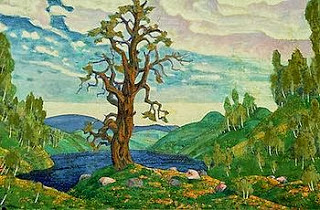
Concepts design for Act I, for 1913 production

A pagan rite
And yes, Diaghilev's idea was to stage a pagan ceremony. Indeed, the play stages a rite of ancient Russia where its primitive inhabitants make a human sacrifice to end winter and help bring the light and warmth of nature back. As Stravinsky recounts in his autobiography of 1936, the idea had already arisen early in his imagination: "One day [in 1910], while working on the last pages of The Firebird in Saint Petersburg I had a fleeting vision ... I saw in my imagination a solemn pagan rite: sage elders, seated in a circle, watching a young girl dance herself to death. They were sacrificing her to propitiate the god of Spring. Such was the theme of the Sacre du Printemps".

Igor Stravinsky (1882 - 1971)
The musical revolution
Leaving aside the highly novel staging, with almost no specific plot and that one scholar describes rather as a "succession of choreographic episodes", The Rite of Spring completely revolutionized the musical language in vogue, subverting the three basic components of music: melody, rhythm and harmony.

The melody is simple in appearance and its motifs "seem" of folk origin, although it is a renewed folklore, in the Bartók style. But its workmanship, its "form", is new and so is the insistence with which Stravinsky repeats the themes relentlessly, without any intention of leading them to their traditional "development".

Added to this are bitonal exercises, that is, the superposition of two or more tones, with the addition of removing or suppressing certain notes to create ruptures of balance and exacerbate tensions in order to achieve a barbaric primitivism.

On the rhythmic level, in addition to the important role assigned to percussion, the listener has a permanent feeling of unpredictability, or brutality and disorder, because the rhythms become irregular by the constant change of time signature or by their highly complex application.

The "weird part" of music
More than a hundred years have passed and to lay listeners or not even so this music still seems "weird" to us. A comment on YouTube is surprised to be "on the weird part of YouTube again" but is glad about it, and thanks Stravinski for having "invented the weird part" of the video host when the Internet did not yet exist. Anyway, with The Rite of Spring, Stravinsky achieved the immortal masterpiece, perhaps the greatest score of the 20th century, with an enormous influence on all subsequent composers and so far one of the most represented and recorded works of all classical music.

The original choreography
Although the work is heard today mostly in an orchestral version, we have preferred to offer here the complete performance, the music together with the choreography, as this makes it easier to approach this new, highly intoxicating and revolutionary experience. The choreography is Nijinski's original, recovered and rebuilt by the Chicago Joffrey Ballet Company in 1980 after been believed lost for almost seventy years. During the Introduction, the curtains are not lifted, and the authors of the video have mounted the credits there. The first scene starts at 2:43.


Tuesday, March 2, 2021

Prokofiev, a story - Piano Concerto No 3


Sergéi Sergéievich Prokofiev was early warned that if he intended to become the best representative of the Soviet school of music composition of the 20th century first half, he was going to have some issues with authority and the established order. At the age of eight, the composer who was later to combine tradition and modernity in an exemplary manner had already composed his first opera, entitled "Giant". The opera ends with the giant defeating a very powerful king, a plot solution that did not please his father, who recommended removing that part because it did not suit a clearly monarchical era. According to the composer's mother, Sergéi did not pay attention to such suggestions and the work was premiered at an uncle's house, with no changes to the original libretto.

Early years - The Conservatory
Born in 1891 in the small Ukrainian village of Sonsovka, the little Sergéi early showed a unique talent for music. So, shortly before Sergéi turned fourteen, his parents, an agronomist engineer and a pianist mother decided his entering to the Saint Petersburg Conservatory. Among his teachers was Rimsky-Korsakov, the star of the Conservatory at that time but from whose lessons Prokofiev did not get any benefit, barely passing the exams. He found the courses unbearable and boring. Consequently, Prokofiev abandoned formal studies at the age of eighteen after receiving the unique diploma of "free artist", due, on the one hand, to his compositional audacity and, on the other hand, to a permanent mutual incomprehension with his teachers.

Private lessons
However, two teachers from the same Conservatory will later provide him with a solid musical background, the fruit of five years of uninterrupted lessons.
He was no longer unknown in St. Petersburg. He was now recognized as a revolutionary for his musical ideas, coupled with a certain intransigence because of his youth. However, his musical predilections would not yet lead him down the path of modernism. Asked in those years for his favourite authors, Prokofiev would name Tchaikovsky, Wagner and Grieg.

Sergéi Prokófiev (1891 - 1953)
Tour through Europe and the US
During the years prior to the October Revolution, Sergéi was not particularly concerned about the course of events, and before the outbreak of the revolution, he responded with a small cantata for tenor, choir and orchestra entitled Seven, they are seven. In 1918 he left Russia, first and foremost because he understood that a country in a full revolution was not the most propitious environment for composing. The end of his long journey through the US and Europe was due to similar reasons. In 1927 he had heard that the Soviet artist, free from material concerns, could devote all his time to creation. Nine years later he settled permanently in Moscow...  he married a Spanish singer, became a father of two children, and turned into a renowned author of a vast instrumental and orchestral work, including chamber, opera and ballet music.

1936, the return
He arrived at a good time because in spite of his flirtations with polytonality and violently dissonant harmonies picked up in his passage through the West, the Soviet authorities had identified his art with the musical conceptions of the revolution. Prokofiev would abandon violent orchestrations and give way to lyricism, also willingly accepting some impositions such as a cantata in homage to the October Revolution with texts by Marx, Lenin and Stalin. Around the same years -1936- his popular symphonic tale Peter and the Wolf was unveiled.

But as nothing lasts forever, ten years later his opera The Story of a Real Man will receive the rejection of the Central Committee, warning in it a certain "formalist and anti-popular orientation" that would be wreaking havoc on Soviet artists, including Shostakovich and Kachaturian, both authors of a work that "reveals in a particularly evident way formalist deviations and antidemocratic musical tendencies foreign to the Soviet people and their artistic tastes."

The end
Not many years of life remained for Prokofiev. Neither did Stalin. But no one expected them both to die on the same day, March 5, 1953. As a result of this ominous coincidence, for three days, as the throngs gathered to mourn Stalin, it was impossible to carry Prokofiev's body out of his home for burial. Furthermore, the newspapers only reported his death several days later.


Concerto for piano and orchestra No. 3, opus 26, in C major
(Use of headphones is recommended)

Of the five piano concertos written by Prokofiev between 1911 and 1932, No. 3, composed between 1917 and 1921, is the one that has garnered the greatest popularity, mainly due to its exceptional melodic and rhythmic innovations.

The concerto was premiered in Chicago on December 16, 1921, with Prokofiev performing as a soloist. In the rendition presented here, the extraordinary Chinese pianist Yuja Wang is accompanied by the Royal Concertgebouw Orchestra conducted by the Italian maestro Daniele Gati. Recording of October 3, 2010, at the Concertgebouw Hall in Amsterdam.

The concerto is in three movements, about ten minutes each: 

Andante - Allegro It opens with a clarinet solo that the orchestra will later take for its development. After a couple of measures, the lyricism of the melody is interrupted at 1:25 by the exuberant entrance of the piano introducing the allegro. The dialogue between orchestra and soloist begins. They will end in unison in an awesome manner.
["Intermezzo" 10:00  At the reproachful or perhaps furtively lascivious look of the conductor, Yuja stretches her skirt, aware that she is showing off a lot of leg.]

Tema con variazioni (10:10) The central theme, in E minor, is followed by five variations. The movement ends in absolute stillness. (Inexplicably, in the beginning, the video puts the legend "Richard Strauss, Don Juan Op 20", a symphonic poem that obviously does not call for a piano, and even less as a soloist).

Allegro ma non-tropo (19:53) Notwithstanding the slow theme of 22:27, which at times seems to pay homage to the exiled Rachmaninov, this is the most overtly virtuous movement in the work. After a novel bitonal passage (the orchestra in G major and the piano in D major), the coda explodes in a hard battle between orchestra and soloist to finally converge in C major, the initial key, in a dramatic fortissimo.

Saturday, February 20, 2021

Pergolesi, La Serva Padrona


At the beginning of the eighteenth century, opera staged in the main European cities had for some time been oriented almost exclusively towards bringing to the stage, using elaborate productions, the great passions and memorable events of classical antiquity. This was accompanied by the emergence of certain idolatry for tenors and castrati, as well as an incipient divismo practiced by the prima donnas.

Intermezzi
But, apparently, the public had begun to tire of so much artifice, and of course, also of the tragic theme. Therefore, it was necessary to begin to include, in the middle of the "serious" operas, some brief pieces, called intermezzi, with a deliberately cheerful and even carefree character, destined to distract of so much tragedy to a public also new, the bourgeoisie.

Simple heroes
These intermissions were a respite from the mythological themes, the preening heroes and sublime sacrifices, showing completely opposite characters, born of the simplest of human vices and defects. Then, flirtatious females, jealous husbands, the cunning of young lovers and, by the way, the rages and outbursts of deceived tutors enter the scene.

Pergolesi and "La Serva Padrona" 

Giovanni Batista Pergolesi
(1710-1736)
Some of these intermezzi were transformed over time into true masterpieces. The best example of this is the two-act work La Serva Padrona (The Maid Turned Mistress) which, according to scholars, implanted the germ of the new opera or comic opera. The new work was born from the inventiveness of the Italian composer Giovanni Battista Draghi, also surnamed Pergolesi as his family came from the city of Pergola.

An autonomous work, until today
The piece, written in 1733 as an intermezzo to another "serious" work by the same composer, was so successful as a refreshing interlude that a few years later it was performed as an autonomous work, becoming a comic opera in its own right. Although with modest periodicity, it continues to be performed to this day, and its author is still remembered for it, as well as for his notable contribution in the field of sacred music, where a famous Stabat Mater stands out.

Unfortunately, Giovanni Battista Pergolesi did not live long. He died in the city of Pozzuoli at the age of 26, probably from tuberculosis.

The characters
There are only three: Uberto, an old bachelor, his maid Serpina who has ruled over the patron's house, and a mute actor, Uberto's servant. In the scene of Act I presented here, the arrogant Serpina informs her employer, Uberto, that he is forbidden to leave the house and that from now on she will be the one giving orders.

After the usual entanglements, Uberto discovers that he has always been in love with Serpina, so he ends up marrying her. Thus, Serpina truly becomes the mistress of the house, the padrona.

Serpina: the Italian soprano Patricia Biccire.

Tuesday, February 16, 2021

Mozart, Piano Concerto No 27

 
Between the years 1782 and 1786, Wolfgang Amadeus Mozart published and premiered in Vienna a staggering fifteen piano concertos. They were part of his public performances which, apart from the lessons to his pupils, were the natural way for a composer who did not have the favor of a court to generate income in those years. According to custom, the performances included the presentation of singers and other various numbers to give the Viennese public a varied program so that interest would not wane during the four hours that the concerts usually lasted. Of course, the total income had to be shared among all the artists.

Letter from Mozart to Puchberg, requesting a new loan. August 14, 1790

The bad times
In 1787 Austria started an unpopular war against the Ottoman Empire. The Viennese aristocracy decided then to concentrate their interest on protecting their property and shielding their children from conscription. Accordingly, the number of pupils and the interest in attending musical performances decreased notoriously. As a result, two years had to pass before Mozart wrote a new piano concerto, the one called "of the Coronation", in 1788, and the last of them, the Concerto in B flat, dated in his catalog on January 5, 1791, exactly eleven months before his death.

Constanze Mozart (1762 - 1842)
M. Puchberg, the helping hand
At the end of 1789, with the laurels of The Marriage of Figaro (1786) and Don Giovanni (1787) somewhat withered, Wolfgang's financial situation was not of the best. When Constanze gave birth to a daughter in November of that year – who lived a mere six months – he had just two pupils, so he was once again forced to seek financial support from the incredibly generous Michael Puchberg, a prosperous Viennese merchant and fellow mason of Amadeus.

Not a few authors have ever sought help from a patron of the arts, but none have done so in a more compelling and heartbreakingly than Mozart.

In June 1788 Mozart wrote Puchberg:

"I still owe you eight ducats. Apart from the fact that at the moment I am not in a position to pay you back this sum, my confidence in you is so boundless that I dare to implore you to help me out with a hundred gulden until next week, when my concerts in the Casino are to begin."

Puchberg apparently sent the money. Then Mozart asked for an even bigger favor:

"If you have sufficient regard and friendship for me to assist me for a year or two with one or two thousand guldens, at a suitable rate of interest, you will help me enormously!" He made the feeble argument that this loan would enable him to "work with a mind more free from care and with a lighter heart and thus earn more."

The Mason merchant jealously guarded these letters, all, more or less, of the same tenor. Today they are worth far more than he ever lent to the Salzburg genius, who, by the way, was only able to pay off the debt on a couple of occasions.

Concerto No. 27 for piano and orchestra in B flat major, K. 595
In March 1791 Mozart gave one of his last public performances in Vienna. On that occasion, he gave the audience Concerto No. 27 for piano and orchestra.

Unlike the brilliance of the immediately preceding concerts, this is an intimate work, with a cozy character and without the slightest trace of spectacularity that the soloist or orchestra could make use of. At times mysterious, at others luminous or tragic, the work builds its unity on a brilliant mixture of intensity and elegance.

Movements:
Allegro  On a very simple accompaniment lasting a single measure, the strings begin a beautiful cantabile melody punctuated by short interventions by the woodwind instruments. The sense of elegance and restraint is enhanced by an instrumentation that omits trumpets and tympani. At 2:55 the piano makes its entrance redrawing the initial motif.

Larghetto (14:25)  Cataloged by some as "religious", a very simple theme is offered by the solo piano with the utmost innocence; it shows a little elaboration, only when Mozart considered it essential. A second idea, the most recognizable despite its brevity, in 15:17. It reappears at 18:57.

Allegro (21:08)  Of calm candor, its first theme recalls the song that Mozart consecutively added to his catalog, the celebrated Sehnsucht nach dem Frühling (Longing for Spring, K. 596).

The rendition is by the brilliant Portuguese pianist Maria Joao Pires, accompanied by the Chamber Orchestra of Europe, conducted by British conductor Trevor Pinnock.

After the concert, Maria Joao Pires offers us a couple of encores: Allegro and Andante from the sonata in D major for four hands (32:30), accompanied by the conductor who, of course, is also a pianist.

Friday, February 12, 2021

Franz Schubert, Impromptus Op 142


In the painting, a view of Kettenbrücken street, in the town of Neu Wieden, near Vienna. Ferdinand Schubert, Franz's older brother, and also a musician and composer, had his rooms in these buildings.
Franz Schubert moved there at the end of the summer of 1828 in search of healthier airs than those Vienna had to offer. He was ill and urgently needed his lungs to clear up, so that he could start composing again. Besides, he wanted to improve his knowledge of counterpoint and fugues technique.  For that, he needed time and a renewed mood.

Depression and the death of the idol
For two years his health had seriously deteriorated. The rejection of his nomination for the vacant post of court chapel director was followed by the death of the revered Beethoven in 1827. Franz fell into a severe state of depression. It is true that Beethoven's luster perhaps darkened Schubert's own brilliance, yet this did not prejudice Franz against him, although on one occasion he expressed serious doubts to a friend that anyone, including himself, was capable of surpassing the master. On Beethoven's death, despite his frail health and intolerable depression, little Franz, together with all his friends, accompanied the cortege, carrying one of the torches himself, as tradition has it.

Franz Schubert (1797 - 1828)
Despite his weak spiritual condition, Franz's creative genius did not wane. From that year are, among others, the Trios for piano and string, the Musical Moments and the highly celebrated eight Impromptus, composed in the autumn of 1827, and which make up Opus 90 and 142. It was not until that year that Viennese publishers began to glimpse that they might have before them a musician of true worth.

The end
Perhaps this explains that only the first two of the four impromptus of Opus 90 (or D. 899, according to the reviewer of his catalog, Otto Erich Deutsch), were published during the composer's lifetime.

The remaining two and the four impromptus of Opus 142 (D. 935) only saw the public light in the year 1857, almost thirty years after its composition and the death of their author, in the most absolute poverty and graciously lodged in the house of his brother Ferdinand.

His possessions at the time of his death, at the age of 31, were some clothing and a good number of scores, the value of which was estimated at 63 guilders. The funeral expenses amounted to 270.

Four Impromptus, Opus 142
Schubert's Impromptus are perhaps the composer's "little pieces" that have grown in popularity. More or less close to Chopin's nocturnes, they nevertheless possess their own personality and clearly show a deep and solid romantic musicality, even exhibiting a certain dramatism within the grace and charm that is proper to them.

The four impromptus are presented here as a complete work – following the concert tradition – in the rendition of the Russian pianist Alexei Volodin.

00:00  N ° 1 in F minor. Written in rondo form: a main theme alternates with a contrasting one.

09:28  N ° 2 in A flat major. Its opening bars are vividly reminiscent of those of Beethoven's Sonata No. 12. Schubert has likely "borrowed" them, it was not uncommon at the time.

16:49  N ° 3 in B flat major. Perhaps the most popular of all. A theme with variations. In this case, Schubert lent himself the main theme, taking it from the incidental music that he was asked to compose for the theatrical drama Rosamunda.

26:46  N ° 4 in F minor. An intense piece, the most demanding of all the Impromptus. It ends spectacularly with a right-hand scale that runs across the keyboard from one end to the other.