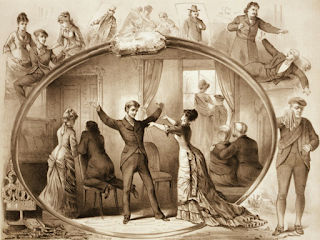
Franz Joseph Haydn was always aware that, in terms of looks, he was not an Adonis. According to one of his biographers, he once expressed that he could not understand how he had been loved by so many beautiful women in his life: "they could not have been captivated by my beauty", he said. However, at the age of 27, his first love affair not only failed to bear fruit but took the wrong path.
Maria Anna
While serving Count Morzin in Vienna, the composer became enthusiastic about Therese, the daughter of a hairdresser, but Therese was not cut out for marriage and soon after entered a religious order. The hairdresser father then offered the older sister, Maria Anna. In November 1760, they were married. Whole life will Maria Anna accompany Haydn, in a marriage that knew neither children nor happiness.
Luigia
A profound connoisseur of the personnel in his service, Prince Nicholas of Esterházy fully understood the reasons Haydn obliquely put forward for the mediocre Italian singer Luigia Polzelli to remain at court despite her scraggy talents when Nicholas wanted to dismiss her in 1780. Eighteen-year-old Luigia had arrived at the palace a year earlier, and shortly thereafter began a relationship with the maestro that lasted until 1791, when the relationship ran out of steam on its own.
Marianne
Apparently, the master was more interested in Mrs. Maria Anna von Genzingen, named Marianne in the intimacy. Wife of the personal physician of Prince Nicholas and an accomplished amateur pianist, she maintained with Haydn a mainly epistolary but abundant relationship, which only ended with her sudden death in 1793 at the age of 38. Haydn was sixty-one.
Sonata in E flat No. 59
For Marianne von Genzingen was written in 1790 the sonata for pianoforte in E flat, one of the most exquisite of the master. In a letter announcing his dedication to her, Haydn asks her special attention for the second movement:
"...for it contains many things which I shall analyze for your grace when the time comes; it is rather difficult but full of feeling."
Movements:
00Allegro
08:03Adagio e cantabile
17:28Finale: tempo di minuet
The rendition is by the outstanding Austrian master Alfred Brendel.
From his deathbed in October 1849, Frédéric Chopin bequeathed to one of his musician friends the method for piano he had been working on so that he could finish it. The chosen friend and recipient of this legacy was a pianist three years younger than Chopin. His name was Charles-Valentin Alkan, and he had been an extraordinary child prodigy who had entered the Paris Conservatory at the age of six, when the Polish musician was nine and could not imagine a future life in Paris.
The beginnings Born in 1813 in the Jewish quarter of Paris to a musician father, Charles-Valentin Alkan got tired of winning first prizes at the Conservatory. The solfège was his first, at the age of seven. At eleven he won the piano prize; harmony at fourteen, and at twenty-one the organ prize. He quickly made a name for himself in the Parisian salons as a young and talented pianist, easily joining the intellectual circles in which Franz Liszt, Victor Hugo, Chopin, George Sand, and Délacroix were active. There was no shortage of evenings and recitals in which he was seen at the piano alongside Liszt or Chopin.
Charles-Valentin Alkan (1813 - 1888)
The isolation But his markedly introverted nature drove him away from the madding crowd at age 25. The salons of Paris thus knew the first of his retreats. For the next 35 years, he appeared in public occasionally, albeit always back and forth. In 1853 he offered two highly acclaimed concerts. After this, despite his recognition and fame, the musician left the scene for the next twenty years, returning only in 1873 to offer six Petit Concerts in the halls of the Erard house.
Douze Études, opus 39 - Étude No 7 Little is known of Alkan's activity during his periods of seclusion, except that he read the Bible and, of course, composed like a man possessed. His catalog reached 76 opus numbers, mainly solo piano pieces, which claim superb technique. One of his most ambitious works is the set of Douze Études for piano, in all minor keys, from 1857. The twelve pieces comprise, in this order, a "symphony" (the first four), a "concerto for solo piano" (the next three), a theme with variations, an overture, and three independent pieces. The Finale of the "concerto", Étude No. 7, is presented here.
The rendition is by Dutch pianist Bas Verheijden, recorded during a rehearsal.
The Finnish composer Jean Sibelius suffered from something similar to what today we would call "stage fright". His first instrument was the violin, and his early performances as a young man gave him hope of becoming a virtuoso on the instrument. He was not in the wrong direction, because at the age of twenty he had a technique that allowed him to tackle demanding works quite properly, let's say Mendelssohn's Concerto, among them.
But he had begun to study the instrument formally a little late ‒at the age of fifteen ‒ and, perhaps too aware of it, he showed before the public a certain nervousness that prevented him from handling the bow with the required ease. He had to give up his dream, a painful renunciation that would be compensated by the universal recognition of his work as a composer in his maturity.
Violin Concerto in D minor, Op 47
But the renunciation was not total. Before he was forty, the composer was able to transfer his intimate knowledge of the violin to a work born of his own creative imagination, the Concerto for violin and orchestra in D minor, completed in 1903. Conducted by Sibelius, the work was premiered in Helsinki on February 8, 1904, but failed to captivate the public, being received rather coldly.
Jean Sibelius (1865 - 1957)
Somewhat surprised but not defeated, Sibelius withdrew the work from the stage to revise it. In October of the following year, Richard Strauss premiered a new, shorter version in Berlin. The public at large was not moved either. It was only in the thirties, after one of the most remarkable violinists of the twentieth century, the Lithuanian Jascha Heifetz recorded the work, that the concerto caught on with audiences thus becoming one of the most popular works of "nationalist" romanticism.
Maestro Sibelius once advised his pupils never to abuse the patience of the audience by writing long orchestral passages. In the revised version, Sibelius followed his own advice to the letter: the violinist begins the main theme four bars into the allegro and does not leave the center of the action for the entire half-hour of the concerto.
The rendition is by Korean American violinist Sarah Chang, accompanied by the Radio Philharmonic Orchestra of the Netherlands, conducted by Dutch conductor Jaap van Zweden.
Movements:
Allegro Moderato / Adagio di molto - 17:23 / Allegro, ma non tanto - 25:13
The remarkable French pianist Marie-Felicité-Denise Pleyel, née Moke, and the pianist and piano maker Camille Pleyel, admirer and friend of Chopin, united their lives in 1831 shortly after Marie-Felicité-Denise broke up with her fiancé, the musician Hector Berlioz, whom she notified of her decision in a letter to Rome, where the musician was enjoying a scholarship. For a few days, Berlioz ruminated on an act of real revenge that included the execution of the pianist and then his suicide, although on the way to Paris he came to his senses, for Marie-Felicité-Denise's fortune and his own.
"La Camilla" But the one who, to Berlioz's detriment, had won the favors of "la Camilla" – as Liszt and his friends called her, in Spanish – did not fare any better either. Only five years after swearing mutual fidelity and care in sickness and in health, they divorced after Camille Pleyel managed to prove to the authorities the multiple and repeated infidelities of Marie-Felicité-Denise, 23 years his junior. The case and other related matters were enough to perpetuate, among Pleyel's male colleagues, the image of the remarkable artist as a femme fatale.
Camille Pleyel (1788 - 1855)
Camilla's friends Indeed, the friends of "la Camilla" were not few. Liszt in the foreground and documented lover. On a less affective level, Mendelssohn and Schumann, the writers Alexander Dumas and Gerard de Nerval, and the painter Eugene Délacroix were among her most famous admirers, whom, it seems, she did not shun while she was Madame Pleyel.
A triumphant career
The announced divorce, far from negatively affecting the already famous artist, was the starting point of an even more successful professional career. From 1836 to 1846 she made triumphant tours of France, Germany, Austria, Russia, and England, surprising the audiences with her virtuosity, which was exceptional for the time for a female pianist. Liszt, as a colleague, pointed her out as "not only a great pianist but one of the great artists of the world".
Marie Pleyel (1811 - 1875)
Madame Pleyel, dedicatée
Frédéric Chopin, to whom Camille Pleyel supplied pianos, could not stay behind in the recognition. The three nocturnes of Opus 9, published in Paris in 1832, are dedicated to her, "to Madame Pleyel", for that year she still was, properly.
Nocturne Op. 9 No. 3, in B major
According to connoisseurs, although less popular than its opus partners it is the most accomplished of the three. Anticipating the more mature nocturnes, this is the one that most clearly delineates the A-B-A pattern established by John Field, the inventor of the form.
A graceful if somewhat obscure melody opens the first section which, despite its simplicity, presents a challenge to the performer, who must stretch his or her ability to produce a delicate sound. The middle section (3:52) is more agitated, almost martial. An abrupt harmonic change at 5:12 allows the first section to be resumed.
The rendition is by Ukrainian pianist Anna Fedorova, born in Kyiv in 1990.
Although he was affable and even simple in his dealings with friends, the German composer Richard Strauss did have a reputation for arrogance and pride. Life had favored him generously, from his birth in a wealthy and musically rich family environment where he never lacked for anything to the long existence he enjoyed without major setbacks. So, it is not surprising that he saw himself as an artist of privileged and exclusive talents, which, of course, he was quick to show early on.
At the age of 16, his First Symphony was premiered; at twenty his name reached North America with the premiere in New York of the Second Symphony. Five years later, the tone poem Don Juan opened the doors of the world's stages, and at the age of forty the opera Salome made him the most famous composer of his time... Richard Strauss, mature, had something to be proud of.
von Büllow's assistant
In 1884, after hearing Strauss conduct a work without prior rehearsal, the prestigious pianist and conductor Hans von Büllow recommended the 20-year-old as chorus master and his assistant conductor in the celebrated Meiningen Orchestra, which von Büllow was in charge of. In return, Richard Strauss wrote a scherzo for piano and orchestra for his benefactor.
Richard Strauss (1864 - 1949)
A difficult work The benefactor, however, refused to study it. He claimed that the piano part was untouchable, especially for small hands, as was his case. Strauss agreed and put the piece aside for some time until in 1889 he met a Liszt pupil, the pianist Eugen d'Albert, who suggested some changes that Strauss gladly took up. The piece, dedicated this time to d'Albert, and renamed Burlesque, was premiered in Eisenach, Bach's birthplace, on June 21, 1890.
Burlesque for piano and orchestra With a novel orchestration, the work gives an important participation to the timpani. Its title refers to its parody character, in the style of mid-century burlesques intended to mock some other work, usually an opera.
The rendition is by the Berlin Philharmonic, with Martha Argerich at the piano and Rainer Seegers on timpani, conducted by the late Italian maestro Claudio Abbado.