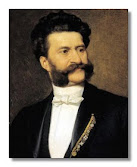
When Die Fledermaus was premiered in the crowded and famous Theater an der Wien, on April 5, 1874, the Viennese citizens were in no mood for celebrations. Although less than a year earlier Vienna had hosted the first World's Fair in a German-speaking region, at the same time the booming capitalism was beginning to experience the first and largest of its recurrent systemic crises, following the collapse of the Vienna Stock Exchange and the immediately subsequent bankruptcy of a powerful banking institution in Philadelphia. The depression, known as the Long Depression, was global in scope and lasted until 1879.
Life on the downside
The economic panic brought down fortunes overnight and hundreds of businesses, including theaters, were affected. As a result, the Viennese bourgeoisie was forced to opt for a rather more austere lifestyle, much to its regret... The Viennese of then, those who in 1850 enjoyed their leisure time drinking in beer halls and cafés and fulfilling the seats of theaters and concert halls, were no longer the same in 1874.
Johann Straus II (1825 - 1899)
Anyway, a success
Despite the adverse conditions, the three-act operetta Die Fledermaus, the most famous of the 16 operettas composed by Johann Strauss Jr, was a remarkable success on the day of its premiere. To this day it remains part of the standard repertoire in its genre, although it is its overture that takes the cake. As an everlasting tribute to the Strauss family, the overture is performed every year for the New Year's Concert in Vienna, ever since the Musikverein began the series of concerts welcoming the new year in the early thirties.
Die Fledermaus - Overture The 2010 version is presented here, with the Vienna Philharmonic conducted by the French conductor Georges Prêtre. The tune that everyone is able to recognize and which identifies the work can be heard from minute 3:05 onwards.
The Viennese citizens will have been reconciled with life, we presume.
As far as we know, there is no other composer in the history of Western music who, along with his creative activity, has successfully worked in a profession so far away from the inner life that musical art entails, such as insurance sales. Indeed, the American composer Charles Ives achieved an enviable financial position shortly into his adult life, becoming a respected insurance professional before the age of 35. With his life financially solved, he went on to dabble in music.
Early Years Born in Danbury, Connecticut, on October 20, 1874, Charles Edward Ives' musical talent quickly revealed itself. At the age of 10 he was playing drums in the band his father directed, at twelve he was a skilled organist at Sunday services at the local Presbyterian church, and by thirteen he had composed his first piece: a sort of requiem in tribute to his dead cat. He entered Yale at the age of 20 and not without effort four years later received his diploma after submitting an interesting if somewhat conventional symphony.
A successful executive As a graduate working as an organist at the Central Presbyterian Church in New York and facing the difficulties of the job, he realized that he was living in a country where the process of capitalist accumulation and the emergence of new types of property was gaining momentum, while insurance was becoming an increasingly promising activity in the service sector. In 1902 he decided to try his luck. Soon after, he became independent and together with a friend founded the first Life Insurance Mutual in Manhattan.
Charles Ives (1874 - 1954)
Within a few years, Charles Ives had become a successful insurance executive who, while riding the commuter train from his home to his Manhattan offices, would compose music with complete freedom, not caring what the world would think of his work.
"Unanswered Question" Written for trumpet, winds and string orchestra, the work is one of the two short orchestral pieces that made up the diptych Two Contemplations of 1906, where, according to scholars, the composer's language and musical ideas can already be seen. It is a sort of "nocturnal music" for strings on which a protagonist trumpet stands out, carrying the melodic line, and asking a question, superimposed on an orchestral ensemble to which it does not seem to belong.
Bernstein's opinion In 1967, Leonard Bernstein gave the following masterful description of the work:
"Ives assigns this question to a solo trumpet who intones it six separate times. And each time there comes an answer, or an attempt at an answer, from a group of woodwinds. The first answer is very indefinite and slow; the second is faster, the third even faster, and the sixth so fast it comes out like wild gibberish. These woodwinds, according to Ives, represent human answers, growing increasingly impatient and desperate, until they lose their meaning entirely. And all this time, right from the beginning, the strings have been playing their own music, infinitely soft and slow and sustained, never changing, never growing louder or faster, never being affected by that strange question-and-answer dialogue of the trumpet and the woodwinds. It is as though the strings were the great galaxy of stars, which keeps slowly, imperceptibly circling about over our heads, as we ask questions and try to give answers..."
Andrés Orozco-Estrada conducts the Frankfurt Radio Symphony Orchestra.
Francisco Tárrega, the author of the famous tremolo Recuerdos de La Alhambra, suffered an accident in his childhood that seriously damaged his eyes when he was already showing signs of musical talent. His guitarist father, fearing that later on the young boy might lose his sight completely and be crippled for life, decided that his son's profession should be music because, blind and all, it would allow him to earn a living. Going one step further – so that future life would not seem ominous to Francisco – he had him take lessons with two blind teachers, one after the other. After a few years, the pair of blind men had done their job to perfection.
In Barcelona
From then on, a renowned concert guitarist from Barcelona took him under his tutelage, whose teachings made it possible for Francisco Tárrega to enter the Madrid Conservatory at the age of 22 to study composition. He also studied piano, following the advice of his father, who was aware of the guitar's weaknesses as a concert instrument.
But after hearing him play on a stupendous concert guitar, his composition teacher understood the potential that the instrument held in Tárrega's hands, encouraging him to devote all his attention to the guitar and forget about the piano.
The classical guitar
Francisco Tárrega (1852 - 1909)
A very fortunate decision. Francisco Tárrega is today recognized for his immense contribution to the transformation of the classical guitar into a solo instrument and its incorporation into the concert hall. Tárrega's nearly 80 compositions for solo guitar and more than a hundred transcriptions of pieces by classical and romantic composers, mostly originally for piano, contributed to this achievement.
Among the most recognized works of his authorship, besides the popular Recuerdos de La Alhambra, stands out for its grace and charm the little piece Capricho Árabe, from 1880, a candid look at the time when southern Spain was occupied by the Moorish invaders for seven centuries.
The rendition is by the young Belarusian guitarist Tatyana Ryzhkova.
The composer who once said: "Music is made by the people and we composers arrange it", came, however, from a noble family, or at least a wealthy one. Indeed, at the time of Mikhail Glinka's birth, his father was a wealthy retired military officer who lived with his family comfortably settled in a village in the Smolensk Governorate, part of the Russian Empire. Over several generations, his ancestors exhibited a long tradition of service and loyalty to the Tsars. It is not by chance, then, that the first work with which Mikhail Glinka will draw attention, an opera, will be entitled A Life for the Tsar.
The first Russian composer Such antecedents will not prevent that during the Soviet Russia, together with Alexandr Pushkin – "the first Russian poet" –, the nomenklatura includes Mijaíl Glinka in the gallery of spoiled artists as "the first Russian composer". The aforementioned enlightened assertion may have helped somewhat, but on the whole, the Soviet authorities were not wrong. Russian nationalism was the first to appear on the scene in European music, precisely by the hand of Glinka, with the aforementioned work of 1836 based on a topic of the 1600s but entirely Russian while in the rest of the European countries would have to wait until the mid-nineteenth century for the nationalist movements to begin to prevail.
The father of The Five Mikhail Glinka, the boy who at the age of thirteen went to study in St. Petersburg to broaden his musical experience is, therefore, the father of Russian musical nationalism. Other Russian nationals would later imbibe from him, including Tchaikovsky and, by the way, the "powerful band" that would go down in history under the name The Five, a fundamental core of Russian nationalism whose musical activity, however, would only unfold its full force some years after Glinka's death.
Mikhail Glinka (1804 - 1857)
A meager oeuvre The composer's oeuvre is not very extensive. In Tchaikovsky's words, "he wrote very little" – he tells Nadhezda in 1878. And although he recognizes Glinka's enormous talent, he seems to reproach him for his class origin when he harshly adds that "he only worked like a dilettante, on a whim, when he felt in the right mood". Although later on he qualifies: "We cannot be dissatisfied with Glinka, but we must admit that he did not fulfill the mission to which his wit had destined him".
Nevertheless, the success of Life for the Tsar encouraged Glinka to compose another opera, Russlan and Ludmilla, although only the overture has survived.
Russlan and Ludmilla - Overture Based on a poem of the same name by Pushkin, the opera was composed between 1837 and 1842 and premiered in St. Petersburg in December of the latter year. The opera is practically never performed nowadays, but its agile overture has become one of the most recognized works in the West. To such an extent, that the American sitcom "Mom" uses it as a unique "musical curtain" between one and another event of the dysfunctional family it deals with, in a comedy tone. Tchaikovsky would be surprised; pleasantly or not, who knows.
The performance is by the Orchestra of Mariinsky Theater, St. Petersburg, conducted by Valery Gergiev.
As, in his own words, "time heals all wounds", eight months after his disastrous decision to marry Antonina Miliukova, the Russian maestro Pyotr Ilyich Tchaikovsky was fully recovered. He had managed to put aside his dark thoughts – including a suicide attempt – and found an insurmountable antidote to preserve his sanity: the creative work.
Yet, even trapped in a marriage to Antonina in May 1877, he completed composing the opera Eugene Onegin the following month. But two months later, when the cohabitation became unbearable, he had no choice but to simply run away from Antonina. He took refuge in Italy. From Florence, he sent the finished Fourth Symphony to Moscow.
A new work
And in February 1878, from his refuge in Clarens, Switzerland, he wrote to his patron Nadezhda von Meck reporting on the state of progress of a new work:
"The first movement of the Violin Concerto is finished; tomorrow I will begin the second. Since the day I began to write this work, I have not lacked the appropriate state of mind. In such conditions, any aspect of fatigue disappears in the composition; it is, on the contrary, a continuous joy. One does not notice the passing of time, and if no one intervened I would be ready to write all day long."
The master, recovered Tchaikovsky is happier than a clam at the Pension Richelieu, the composer's favorite quiet corner of Switzerland. And he is not alone. He is accompanied by his brother Modest and his young servant Alyosha. Soon, Piotr Ilyich will also receive a very welcome visitor: his disciple Iosif Kotek, a 23-year-old violinist who will be of great help to him in rehearsing certain complex passages of the new concerto, since the master does not have a good command of the violin. Kotek's suggestions will eventually persuade the master to write a new Andante and introduce modifications to the first movement. The young pupil, however, will refuse to premiere it because he does not feel capable.
Kotek and Tchaikovsky, in 1877
Concerto for Violin and Orchestra in D major, Op. 35 There was also a second violinist, Leopold Auer, who declined the honor of playing it on the grounds of the excessive difficulty of the composition. And as with the Piano Concerto No. 1, the work was premiered by someone other than the person for whom it was intended. Adolf Brodsky, a Russian violinist, was commissioned to premiere it in Vienna three years later, on November 22, 1881, thus earning the dedication. The critics were not favorable, but the public loved the work from the beginning. Until today.
It is unusual for a concert piece to become the protagonist of another story. But that is what happened five years ago, with the 2009 Franco-Russian film production, The Concert, where Tchaikovsky's work takes the lead role.
The rendition is by the German violinist (and also a pianist) Julia Fischer, accompanied by the Orchestre Philharmonique de Radio France, conducted by the Russian maestro Vasily Petrenko.
Movements - Listening Guide
Following post-Romantic canons, the concerto is in three movements with the second and third movement connected without a pause:
00Allegro moderato - Moderato assai After the splendid orchestral introduction, the violin, after an introductory phrase, exposes the famous main theme, "moderato assai", at 1:14, to captivate the audience from the beginning. After the exposition (re-exposition, on double strings, 1:51), a "bridge" passage (2:26). Second theme, "molto espressivo" at 3:05. At 4:55, the violin begins to prepare what will be the vibrant attack of the main theme by the orchestra at 6:12. The violin, the protagonist, plays with ornaments and variations on the first theme at 7:45. Virtuosic scales by the violin at 8:49 lead to another attack of the main theme by the orchestra at 8:54, now more pompous and grandiose, although this time it will follow new paths. Orchestra and violin alternate one measure each (9:34) at the threshold of the cadenza: 9:43 (written by Tchaikovsky, it quotes the introductory motif at the beginning and both themes). Recapitulation: the orchestra takes the first theme, more lyrical and serene at 12:22 with the violin playing trills. Orchestra and violin dialogue. 13:29: second theme. Marked poco piu mosso (a little more moving) it heads to the end at 13:45, crescendo; orchestra and violin respond to each other at 15:45, then embark together on the conclusion to a brilliant finale.
18:32Canzonetta. Andante. A sweet and melancholy theme, introduced by the orchestra. It is taken by the violin at 19:12. This is followed by the flute at 20:23. A second theme at 20:43. Development and variations. Clarinet and violin dialogue. Winds and woodwinds take the lead at 23:42, establishing a somber atmosphere, after which the third movement will enter without pause at:
24:41Allegro vivacissimo. A rondo. The orchestra introduces a Russian theme, cheerful, which will immediately take up the solo violin at 24:55, with a brief intermission cadenza. At 25:02 the calm main theme is resumed. At 25:28 the tempo primo returns. A second theme, more lyrical, is introduced by oboe and clarinet at 27:27, taken up by the violin at 27:47, developing it. Return to the first theme featuring the violin, vivace, at 28:38, to quiet down at 30:01. Return to the tempo primo at 30:24. The orchestra takes up the second theme at 31:00, meno mosso, then individual instruments dialogue with it, including the violin, almost andante, at 34:07. Calm before the storm, at 32:12. The violin falls silent at 33:33 and the orchestra begins the resolution. At 33:48, a spirited final confrontation between violin and orchestra, heading toward the conclusion, full of panache and gallantry.