Páginas

Saturday, January 29, 2022

Beethoven, Septet op 20


By the time he composed his only piece for the unusual combination of seven instruments (three wind, four strings) – also called Septet and completed in 1800 – Beethoven was 30 years old, had been settled in Vienna for seven years, and deafness had begun to trouble him seriously. But it was still two years before he confessed his unfortunate situation to his brothers in the famous Heiligenstadt Testament. In the meantime, he developed a huge chamber music production to satisfy the musical craving of his noble friends.


But it was also not bad appealing to a wider audience. That is why, in December 1800, in connection with the Septet already published, Beethoven wrote to his publisher: "...in view of the customs, the three wind instruments could be transcribed... for one more violin, one more viola, and one more cello...".

It happened that the nobility and gentry had just discovered nature. So, the music that bourgeois and noble amateurs could play in open-air gatherings was in great demand. For the same reason, the Septet was an immediate success from its release, although Beethoven will always maintain a certain distance with the work. He would later say: "...there is a lot of imagination in it but little art.... At that time I did not know how to compose, now I think I do".

A handsome Beethoven, in 1803
Septet in E flat major, opus 20
Nevertheless, the work exudes great enthusiasm and energy, with no shortage of captivating and attractive solos for the instrumentalists to show off. Written in the style of the divertimentos and serenades of the closing century, its six movements certainly evoke the spirit of those forms that Haydn and Mozart had cultivated with such brilliance and elegance.

Surely made known previously in some prince's parlor, its public premiere took place at the Burgtheater in Vienna on April 2, 1800, together with the Symphony No. 1 and the Piano Concerto No. 2.
It is dedicated to Empress Maria Theresa of Austria, whose strict connection to the maestro we have found somewhat difficult to elucidate.


Movements
Written for violin, viola, cello, double bass, clarinet, bassoon, and horn, the piece consists of six movements:
00       Adagio. Allegro con brio
10:57  Adagio cantabile  
20:47  Tempo di Menuetto  -  borrows its theme from the first movement of the sonata facile Opus 49 No. 2, an earlier composition despite its opus number.
24:02  Theme with variations. Andante 
31:36  Scherzo. Allegro molto e vivace 
34:42  Andante con moto alla marcia. Presto

The performance is by Janine Jansen, leading a group of instrumentalists that the Dutch violinist refers to as "her friends".

Friday, January 28, 2022

Olivier Messiaen, Quartet for the End of Time - VI mov


On the train to the concentration camp, French composer Olivier Messiaen met a colleague in art and arms, clarinetist Henri Akoka, who, like him, was being transferred as a prisoner of war to a prison camp outside Görlitz, German territory that today belongs to Poland. In order to make the difficult circumstances more bearable, during the journey, Messiaen entertained himself discussing with Akoka the sketches of a clarinet piece that would later become part of a larger work, the Quartet for the End of Time, composed in the very same concentration camp a few months later.

A renowned composer
At the time, Messiaen was 31 years old and already recognized as one of the most remarkable French composers of his generation. The son of a literature professor and a poetess, the musician had grown up in an environment favoring artistic creation. A brilliant student at the Paris Conservatory, he made the organ his professional instrument of which he became an accomplished performer.

Deeply religious, his music drew inspiration from the Catholic faith as well as from Hinduism, forming a personal style that stands out for its rhythmic and harmonic richness. His richness of timbres is not far behind, sustained by a great love for nature and birdsong. All this was no impediment to his being captured by the Germans in June 1940 during the siege of Verdun and being sent to a prison camp.

Olivier Messiaen (1908 - 1992)
In the prison camp
While in prison, he had the opportunity to meet other soldier-musicians. Among them, a cellist and a violinist. Messiaen set about finishing the clarinet piece offered to Akoka and then composed a trio for the three musicians. A curious wartime indulgence granted to these non-combatant soldiers, brass band soldiers, allowed Messiaen to get an old piano back in Görlitz. The composer then devised a piano part and transformed the trio into a quartet.

Quatuor pour la fin du temps
Premiered in the concentration camp on January 15, 1941, before an audience of about 400 people, including prisoners and guards, the quartet takes its name from a passage in the Book of Revelations in which the angel announces the end of time. The unusual combination of instruments (violin, clarinet, cello, and piano) obeys, naturally, to the peculiar circumstances of its creation. And the uneven participation of them, to the fact that their genesis is very different. Of the eight movements that make up the piece, only half involve the four instrumentalists together. (The third movement is a clarinet solo, Akoka's, as might be expected).

"Dance of fury..."
The complete work lasts 50 minutes. Here we present movement VI, entitled "Danse de la fureur, pour les sept trompettes"", the most characteristic rhythmic piece of the work, and where the four instruments are involved, playing, as a modern curiosity, in unison.

The musicians are: Marta Sikora, violin / Oded Shnei Dor, clarinet / Yedidya Shaliv, cello / Ayal Pelc, piano.

Wednesday, January 26, 2022

JS Bach, French Suite No 3


Maria Barbara, Johann Sebastian Bach's first wife, died at the age of 36, while the master was accompanying Prince Leopold, his patron at the court of Köthen, during a stay in the pleasant spa resort of Karlsbad, a meeting place for the German aristocracy. It was upon his return that he was met with the tragic news that left him a widower with four young children, twelve years old the eldest. He had to find a new mother for his children and a companion for himself.

Anna Magdalena
Shortly after a year, he found her as the daughter of a horn player, the 20-year-old soprano Anna Magdalena Wilcke, who, as soon as she saw him, was vividly attracted by the master's disposition, of whom, as she tells us, "it would be foolish to say he was beautiful" and who, moreover, was sixteen years her senior. They married in December 1721 and had 13 children. A happy union that Bach nurtured day by day. One night, on the eve of the first anniversary of their marriage, he quietly approached Anna Magdalena and placed before her "a little green bound book, with leather spine and corners".

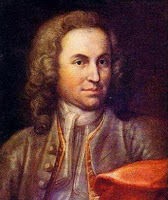
JS Bach (alleged portrait)
(1685 - 1750)
The French Suites
On its first page, one could read the inscription Clavierbüchlein vor Anna Magdalena Bachin, Anno 1772, a collection of simple and charming compositions for harpsichord, of the most diverse genres, choral preludes, minuets, rondos, arias. A few years later, Bach was to rework and complete three of these pieces, giving rise to the first three suites of the famous French Suites – six in all –, works that are as French as the almost parallel English Suites are English. They were once published under the name of Suites pour le clavecin, which is probably the origin of their appellation.

Organization
As a whole, the structure of the six suites is entirely German, or better still, Italian, with its traditional four movements or dances: allemande courante – sarabande – giga, to which are added, in between the sarabande and the giga, a variable number of supplementary movements such as a minuet, a gavotte, bourré, or an aria. Unlike the English suites, they do not include a prelude.

French Suite No 3, in B minor, BWV 814
Seccions:

00       Allemande 

03:28  Courante

05:17  Sarabanda 

07:56  Gavotte

09:18  Minueto I

10:25  Trio

11:21  Minueto II

11:56  Giga

The rendition is by the Hungarian pianist András Schiff, on the occasion of the Bach Festival (Bachfest) 2010, a classical music festival that takes place every year in Leipzig in June.

Monday, January 24, 2022

Manuel María Ponce, Suite in A minor


Only two years after entering the National Conservatory of Music in Mexico City, Mexican pianist and composer Manuel María Ponce felt that he had learned nothing, or at best, very little. So in 1903 he abandoned his formal studies and returned to the family home in Aguascalientes, capital of the state of the same name, where he began to work, at the age of 21, as a private piano and solfeggio teacher. The composer, had to wait...

Popular songs
The traditional National Fair of San Marcos that was held there every year gave him the splendid opportunity to listen to the autochthonous music played by the traveling troubadours who moved from fair to fair sharing their vast repertoire of popular songs. A very rich material that Ponce thought could be the basis for the creation of genuine Mexican classical music. These were the beginnings of Mexican musical nationalism, which Manuel Ponce is regarded as its father, although it was his future student, Carlos Chávez, who would consolidate the movement.

Travelling to Europe
But in order to carry out all this it was urgent to broaden his knowledge, and for that there was no better way than to set off to Europe. So the Mexican composer first ventured to Bologna, Italy, and from there he went to Germany where between 1906 and 1908 he refined his piano technique with none other than Professor Martin Krauze, a former student of Liszt, who shortly thereafter would become Claudio Arrau's teacher and trainer.

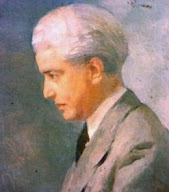
Manuel M. Ponce (1882 - 1948)
A friendship with Segovia
Some years later, after two seasons as conductor of the Orquesta Sinfónica de México, he was assigned to study composition under the guidance of Paul Dukas. There he was fortunate to have Joaquín Rodrigo and Heitor Villa-Lobos as fellow students.
In the new journey he also forged a great friendship with Andrés Segovia, since the maestro Ponce, besides being a pianist, also mastered the guitar. Proof of this are his nearly 40 compositions for guitar, including sonatas, sonatinas, preludes, studies and suites.

Suite in A minor
Presented here is his Suite in A minor for guitar, from 1929, composed while Ponce was pursuing his degree in composition at the Ecole Normal de Musique de Paris, and written specifically in the style of the baroque suite at the request of the friend to whom it was addressed, Andrés Segovia.

Sections:
00 
     Preludio
02:41  Allemande
05:23  Sarabande
09:56  Gavota I y II
12:37  Giga

The rendition is by Armenian guitarist Gohar Vardanyan.

Saturday, January 22, 2022

Chopin, Piano Concerto No 1


When Chopin settled in Paris in 1831, six years earlier the German-born pianist, teacher, and piano maker Friedrich Kalkbrenner had done the same. After a long period in London as a pianist and businessman, he had arrived in the City of Light, the center of European musical activity at the time, carrying the title of "the best pianist in Europe", made up by himself. Twenty-one-year-old Chopin, a newcomer, came to him for advice and contacts. Kalkbrenner offered to make him an accomplished virtuoso within three years if he would take lessons with him.


Chopin hesitates
It is true that Chopin had not had a piano teacher until then. Those who gave him the basic tools were his teachers in Warsaw, but one was a violinist and the other a composer. So it is not surprising that he wrote enthusiastically to his parents and sisters that he intended to stay in Paris for "about three years," precisely the time frame suggested by Kalkbrenner. But his enthusiasm for his potential teacher waned as, with the weapons he already possessed, he dazzled those attending the Parisian soirées where he was invited to play. Finally, Chopin resigned Kalkbrenner's support but he honored him with the dedication of his Concerto in E minor, when it was published in Paris in 1833.

A young Chopin, by Ary Scheffer
The second concerto
It was the second piano concerto Chopin wrote, but the first to be published. For this reason, the publisher assigned it No. 1. The first had been the Concerto in F minor, which would be published three years later, in 1836, and consequently designated as No. 2.
Both were composed in Warsaw, when Chopin was between 19 and 20 years old. They both had their premiere on the occasion of the numerous soirees organized to bid farewell to the young virtuoso who was leaving Warsaw with the idea of being away for "about three years", but who would never return.

Concerto No. 1 in E minor, opus 11
Then and now, there has been no shortage of opinions about the weakness, or the lack of ingenuity or brilliance of Chopin's orchestration. Uninteresting, is the most common imputation. It happens that the young composer does not have as models the Beethovenian or Mozartian concerto, but those of his contemporaries, less notable (Hummel, Hiller, or Kalkbrenner himself), in which the piano is openly the protagonist, with the orchestra on a secondary plane, in charge of the initial exposition of the themes and of underlining the moments of great expressiveness in support of the soloist. What they all agree on is that the piano writing is unparalleled.

Movements:
There are three, typical of the period:
00        Allegro maestoso
21:07  Romance. Larghetto
30:56  Rondo. Vivace

From the Philharmonic Hall, Warsaw, on 27 August 2010. Martha Argerich and the Sinfonia Varsovia Orchestra under the baton of Jacek Kaspszyk.