The famous group of Russian nationalist musicians known as The Five, born in the 60s of the 19th century, had creators among its members who were not always exclusively dedicated to music, nor did they turn it into the profession with which they earned their livelihood. Borodin, an expert in aldehydes, never abandoned his profession as a chemist. Rimski-Korsakov was an officer in the Russian Navy, and César Cui was a military engineer. Balakirev combined music studies with engineering, and Mussorgsky, a military man when young, spent most of his life as a ministry official.
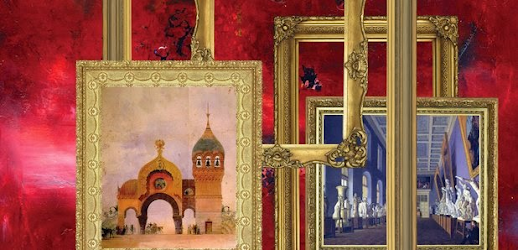
On the verge of oblivion
Now, if we make the exercise of bringing to mind the most relevant musicians of the famous group, Rimsky-Korsakov comes to mind, of course, and secondly, Modest Mussorgsky, although the latter was recognized in his time as an interesting author of songs and operas that will not stand the test of time, with the remarkable exception of his masterpiece in the genre, Boris Godunov. Precious hours will have been taken away from Mussorgsky's musical creation by his work as an obscure clerk, for had it not been for the orchestrations of his works made by colleagues after his death, we would perhaps remember him less than César Cui.
Without going any further, his most popular work, A Night on Bald Mountain, from 1867, was orchestrated by his friend Rimsky-Korsakov in 1886, five years after the author's death, gaining only then the popular favor (and it is even said to be an original work by Rimsky based on pages by Mussorgsky that did not reach completion).
The right guess of Ravel And the case of the piano suite Pictures at an Exhibition, from 1874, is no different (its genesis and description, here). Also published five years after his death, although edited by Rimsky-Korsakov again, it had to wait until 1931 to be published keeping fidelity to the composer's manuscripts. And in spite of being Musorgsky's most finished piano composition and one of the most original creations of Russian romanticism, it only became known to the general public through the orchestral version that Maurice Ravel made of it in 1922. There were many previous attempts, but in the face of the fullness of Ravel's success, these have proved to be "unnecessary", in the opinion of scholars.
Modest Mussorgsky, in 1874 (1839- 1881)
Art and solitude
Modest Mussorgsky did not enjoy a good life. Constantly afflicted by nervous depression and some episodes of epilepsy, he had to face sentimental loneliness, economic hardship, and, at times, the incomprehension of his work by his peers. At the age of forty, Musorgsky was a human being in sorrowful decadence, given in some degree to drink, but even in those conditions, he had the courage to abandon definitively his position as a civil servant and become a modest pianist accompanist in singing schools. From there, sometimes an event would arise, regrettably paid, to accompany at the piano some aspiring diva who was trying to gain an audience.
Posthumous celebrity
Mussorgsky died in a military hospital on March 28, 1881, without ever having known anything close to prestige, or fame. Forty years later, the most formidable orchestrator on record, Maurice Ravel, will provide it, copiously, to keep his name high to this day.
This is the RTVE Symphony Orchestra, conducted by Miguel Ángel Gómez Martínez.
Excluding the long hiatus of almost a year and a half during which he traveled through central Europe with his mother in search of better airs, Wolfgang Amadeus Mozart had to put up with his rude patron, Prince-Archbishop Colloredo, for nine years, from August 1772 to May 1781, when the final break occurred after a harsh debate. From the beginning relations were strained, and from then on they only worsened to the point that the prince-archbishop, during an interview granted to Leopold Mozart in 1777, went so far as to point out to Leopold that his son "knew nothing and what he should do was to go to Naples to learn music at a conservatory".
The six violin concertos Nevertheless, stifled and mistreated by an ungracious patron in the provincial environment of Salzburg, Mozart produced many of his best works there, some of them composed at an astonishing speed. This is the case of the only six violin concertos indebted to Mozart. Today as true masterpieces, No. 3, No. 4, and No. 5 were written in just four months, between September and December 1775, while the vassal Mozart was composing without pause music for religious services and various special occasions.
Concerto for violin and orchestra No. 5, in A major, K. 219 With Concerto No. 5, somewhat crudely called the "Turkish Concerto" (because of the rondo), Mozart managed to create something very much in the line of what the 19th century would come to know as the concerto for solo instrument and orchestra. Although openly framed in the tradition of the "classical" chamber concerto, its long extension -around 25 minutes- and its great technical demand reveal that a new role has been assigned to the violin as a solo instrument. Not a few concertos of similar stature were written at the same time, but none managed to survive the test of time with the gallantry that Mozart's No. 5 has done.
Movements: 00Allegro aperto - Adagio - Allegro aperto - The only instance in Mozart's concerto repertoire in which the soloist makes his first entrance with a brief adagio independent of the orchestral exposition (Allegro aperto: somewhat more majestic than an ordinary allegro).
10:56Adagio - One of Mozart's longest slow movements, with a beautiful passage in the middle section.
21:54Rondo - Tempo di Minuetto - The best-known movement of the work, with an alla turca section, in the prevailing fashion of the time and which Mozart would replicate three years later by introducing a rondo alla turca, the famous "Turkish March", in the piano sonata in A major.
Belarusian violinist Artiom Shishkov is accompanied by the Belgian ensemble Orchestre Royal de Chambre de Wallonie, conducted by the German maestro Michael Hofstetter.
On the web, and in discography, it is customary to illustrate the Sabre Dance with the image of an Arab girl dancing with a sabre on her head, but, actually, there is no oriental dance in which the dancer must practice such choreography. Nonetheless, the image became popular during the 19th century in line with a fashion imposed by French orientalist painters.
La danse pyrrhique
One of these painters was Jean-Léon Gerome, but we have chosen a different painting from him, La danse pyrrhique, to illustrate in a somewhat more genuine way what really happens during the scene The Sabre Dance, from the ballet Gayane, by the Russian composer of Armenian origin Aram Khachaturian. The composer included a suite of dances from Central Asian folklore during the second act. In the middle of two dances of Kurdish origin, the sabre dance evokes a dance of Armenian dancers showing off their skill with the sabre.
A. Khachaturian (1903 - 1978)
The Soviet Homeland... and Armenia Premiered in December 1942, in the midst of the Second World War, the ballet tells the story of a young Armenian woman whose patriotic convictions conflict with her deepest feelings when she discovers that her husband has betrayed the Soviet homeland. Notwithstanding the thematics akin to the revolutionary process, the composer later had to face the customary sequence of confession and rehabilitation, typical of the Stalinist period.
But Khachaturian came out of it unscathed.
Later he devoted himself to composing works for the theater and cinema. He also became the author of the Armenian National Anthem.
Sabre Dance
The famous dance, of great vitality, includes in its middle section a traditional Armenian theme, more lyrical. Its short duration has facilitated its adaptation for cinema, TV, video games, and advertising, through multiple and varied arrangements. The irresistible and immediate attraction that it exerts on the audiences has also transformed it into one of the most recurrent "workhorses" of the great orchestral ensembles, taking advantage of the bunch of orchestral suites that the author extracted at the time from the ballet.
The performance is by the Berlin Philharmonic, conducted by the English maestro Sir Simon Rattle.
It has already been said that Chopin was not fond of crowds. He was uncomfortable with those unknown people who curiously watched him from their seats, and so he told on more than one occasion to his fellow friends, Liszt among them. However, during his first years in Paris, the composer appeared in public much more frequently than he would later become accustomed to. Perhaps, it was an imposition of life. Of course, the self-exiled Pole had a pressing need to make himself known in a strange land.
The collaborative concerts In 1833, when he was 23 years old and had only been in Paris for a little more than two years, he performed at least three times before a large audience. It had all begun shortly before, when in December of the previous year he appeared for the first time in the company of Liszt to perform, together with the pianist and composer Ferdinand Hiller, the allegro from Bach's Concerto for three keyboards. On April 2, 1833, in collaboration with Liszt again, he performed several pieces at a large benefit concert, and the following day, he took part in another concert for four pianos, together with Liszt and two other pianists.
The intimate evenings For sure, Chopin felt most comfortable in the salons of the nascent Parisian bourgeoisie, or at the soirées offered by the Polish nobles, exiled like him. There he could improvise, or deliver the most refined or personal, presenting before a small audience the first audition of a short work that he would have finished, perhaps that very evening. The Polish nobility, of course, would have greeted with effusion the longing for the land that flowed from Chopin's hands if the composer made them listen to a mazurka, for example, fresh from his most personal and intimate world.
Chopin (1810 - 1849)
1833, a fruitful year Among several other works, that year he finished the Etudes of opus 10, published the Concerto in E minor and the three Nocturnes of opus 9. He also finished a new series of mazurkas, those of opus 17, which he published the following year in Paris, adding four more pieces to the collection that, at the end of his life, will have 47 published mazurkas. Posthumously, another ten will be added, those the author did not consider worthy of being published.
Mazurka opus 17 N° 4 Originally from the Mazurian region, the mazurka (mazur in Polish) is a dance in 3/4 rhythm. It is danced, and sung. It also can be sung while dancing. But from their national and popular character, Chopin took merely the rhythm, whose cadence requires a more or less prolonged support of the second or third beat of each measure. With a brief duration, their singing is pure Chopinian invention, thus refining the dance, "ennobling its melodies," in Liszt's words. They are generally enveloped by a harmonic mist, and the last piece of opus 17 goes a bit further, to the point that at the beginning it is difficult to recognize the key in which it is written. It would seem that Chopin is improvising, in a salon, for his Parisian admirers. But he is not. Everything is prodigiously controlled.
The rendition is by the American pianist and composer Michael Glenn Williams.
More than 200 years after its publication, Beethoven's Third Symphony called "Eroica" is still linked to the legend that it was composed in homage to Napoleon, whose dedication Beethoven erased when he learned that the obscure Corsican officer of a few years earlier had crowned himself emperor with the title Napoleon I.
But the legend is not lacking in substance, for although Beethoven eventually dedicated the work to his patron Prince Lobkowitz, the 1806 publication retained the subtitle "composta per festeggiare il sovvenire d'un gran Uomo", which Beethoven might have removed had his discomfort with the Corsican taken on the magnitude that his pupil Ferdinand Ries reports in his memoirs.
Ries's account In May 1804, being the work finished but unpublished, Ries came to Beethoven's house with the news of Napoleon's coronation. According to Ries, Beethoven would have screamed his head off, rushing to the table where the manuscript lay to tear it into a thousand pieces, exclaiming that Bonaparte had finally shown himself for what he simply was: an ordinary human being.
It is this story, with no other witness than both of them, that originated the legend, treated as such by scholars, who, given the existence of the aforementioned subtitle, have had no choice but to assign the "celebration and memory of a great man" (in capital letters) to a grandiose addressee, such as Humanity, for example.
Joseph Franz von Lobkowitz (1772 - 1816)
Another "great man" Beethoven admired Napoleon in his time, as did hundreds of artists and thinkers of the time. That the self-coronation of his hero made him doubt is also possible. But it is not superfluous to add here a matter of concrete life.
Prince Lobkowitz is one of the patrons who, four years after the premiere of the "Eroica", became a member of the so-called "pact of the three princes", by which Beethoven received an annual income of about four thousand florins for staying in Vienna, composing, and attending the evenings of his patrons, where, by the way, the master premiered his works.
Indeed, Symphony N°3, "Eroica", will have its premiere, in private, at Lobkowitz's house. If the hero had already fallen from his pedestal, there was a prince at hand with whom to ingratiate himself with concrete results.
Symphony No. 3 "Eroica" The public performance will take place the following year, on April 7, 1805, at the Theatre an der Wien, Vienna, with Beethoven conducting. The work, magnificent, is the first in which the master departs from the pattern followed by Haydn, adopting a more personal language, which would be characteristic of later Beethoven. Its long duration (about an hour if all the indicated repetitions are performed) and its expressive intensity, both unusual features for the parameters of the early nineteenth century, bring the composition closer to the nascent Romantic postulates, despite the fact that it reflects the heritage, transformed, of Mozart, and also of Bach, through the former.
Movements:
00:23 Allegro con brio
16:25 Marcia funebre. Adagio assai
33:05 Scherzo. Allegro vivace - Trio
38:55 Finale. Allegro molto
The rendition is by the West-Eastern Divan Orchestra, conducted by Daniel Barenboim, from the Royal Albert Hall of London (BBC Proms, 2012).