Páginas

Monday, July 25, 2022

Franz Liszt, Transcendental Etudes, No 4 - "Mazeppa"


Franz Liszt's commitment to composing a cycle of twelve studies for piano took him a long time, about 26 years. It is true that he began quite young since his first approach dates from the time when he had as a pupil the Countess Carolyne de Saint-Cricq, his first and failed love. Liszt was then 15 years old, and decided to imitate the serial studies that were common in those days. In them, despite their simplicity, we can see the seed of his later production.

A second version
A revision of the original twelve etudes dates from 1837. Liszt was at the height of his fame as a piano virtuoso, and as such, the pieces show a significant intensification of technical difficulties, to the extent that his colleague Robert Schumann noted that only a handful of pianists would be able to perform them in a satisfactory manner.

A third version
The third and last version was published in Paris as Études d'Exécution Transcendante, in 1852, and dedicated to his teacher Carl Czerny. Perhaps moved by Schumann's perception, in this version the maestro decided to lighten the virtuosic demands a little, freeing the Études from the excessive pyrotechnics of the 1837 version, and adding, to his advantage, more musical values.
This is the version that is performed today and, of course, the twelve pieces continue to be an enormous challenge for the performers. 

Franz Liszt (1811 - 1886)
Étude No. 4 in D minor, "Mazeppa"
Étude No. 4, one of the most demanding, is inspired by a poem by Victor Hugo, Mazeppa. The poem tells the story of Ivan Mazeppa, a Cossack nobleman who seduces a noblewoman, also noble, but Polish. As punishment, he is tied naked to a wild horse that takes him to Ukraine, where he miraculously arrives alive. After being freed by his Cossack peers, he is named their monarch, in recognition of such a feat.

The work, which attempts to musically reflect the horse's unbridled gallop and the ensuing suffering of the daring Mazeppa, adds to its technical demands an unusual fingering proposed by Liszt, with the pointed purpose of achieving either the required staccato or precise legato.
Later, in 1851, Liszt will recreate the story again, with the same title, but this time as part of his cycle of thirteen tone poems, composed during his stay in Weimar.

The rendition is by the brilliant French pianist Emmanuel Despax.

Bach, Passion according to St. Matthew


Johann Sebastian Bach, the father of harmony, was primarily a church musician, who was aware that church music was primarily vocal music. That is why his oeuvre is punctuated by compositions to be sung, even when he was primarily concerned with the orchestra or solo instruments. From 1723 on, after being appointed Kantor in Leipzig, his dedication to ecclesiastical music became more intense, since his main responsibility was to compose the music to be sung in the divine offices.

The Passions
Cantatas were Bach's daily bread and butter. Not so the Passions, conceived as long works on biblical themes, told the story of Christ's crucifixion according to the gospels and were sung only on Good Friday, in the Lutheran tradition. In the Passions, the historical characters and the evangelist (who leads the narration) are performed by soloists, and the flow of the story rests on recitatives, arias, and choral parts.

Passion according to St. Matthew
As far as we know, Bach would have composed at least five Passions, of which only two are preserved, the Passion according to St. John and the Passion according to St. Matthew. The latter, probably composed in 1729, was first performed on Good Friday of that year in the Thomasschule Church in Leipzig under Bach's baton.
The work, whose text is mainly based on chapters 26 and 27 of the Gospel of Matthew, is written for solo voices, a double orchestra, and two choirs, the latter intended to carry the voice of the believers, on the one hand, and those who ask for blood, on the other, each accompanied by its own orchestral group, hence the "double orchestra".

The oblivion, and Mendelssohn
Like almost all of Bach's works, the St. Matthew Passion fell into oblivion after its author's death in 1750. It was not until 1829 that it was heard again, thanks to a very young Felix Mendelssohn who brought it to the stage in Berlin in an abridged version. Its representation encouraged the interest in knowing the complete work of the father of modern music.

The great final chorus
In our days, Martin Scorsese's film Casino (1995) made an important contribution in favor of the ordinary public by including in the opening credits and in the final scene, the great chorus with which the play ends. It is the cry of the believers before the tomb of the dead Christ: Wir setzen uns mit Tränen nieder ("We prostrate ourselves weeping"), one of the most moving fragments of the work, and whose texts belong to the German poet and librettist Chrystian Friedrich Henrici, also known as Picander.

The performance is by the orchestra and choirs of the Belgian group Collegium Vocale Gent, conducted by Philippe Herreweghe, its founder.

Friday, July 22, 2022

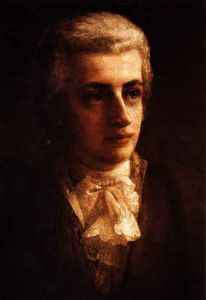
Mozart, Requiem - Lacrimosa


Among the countless myths surrounding Mozart's death, the one that refers to Death itself visiting him to ask him to write his own Requiem stands out. The remaining half-truths, encouraged in our time by the film Amadeus, took shape again for a while: the poisoning by Salieri's hidden hand; the mass grave that turned out to be a shared grave; the absence of his wife Constance at the funeral, a custom of the time; the storm at the burial although that day was clear and bright; and finally, that he died bankrupt... the closest thing to the truth because at the time of his death Mozart had spent the last years robbing Peter to pay Paul.

The classical myth
Now, the classical myth, that of the visit of Death, has some substance, for the mysterious emissary sent to the Mozart home by Count Franz von Walsegg could not hide his sinister appearance because of his cadaverous features. The count, an amateur musician who habitually solicited works from professional musicians to pass them off as his own, had been bereaved of his young wife of twenty years in February 1791. In mid-July, he commissioned his not very handsome secretary to ask Mozart to compose a Requiem Mass, taking care not to give any information about the principal. The person himself was also not identified.

The last days, working hard
Around the same time, Mozart was commissioned to write an opera to celebrate the coronation of Leopold II as king of Bohemia. The work was called La Clemenza di Tito, whose premiere he conducted in Prague on September 6. At the end of that month, he completed the revisions of The Magic Flute, and in early October he did the same with the Clarinet Concerto. So it was only from the second week of October onwards that Mozart could focus on writing the Requiem, on which he worked until November 20, when he fell into bed and never got up again. 

Franz Xaver Süsmayr
(1766 - 1803)
The incomplete task
Mozart passed away in the early morning of December 5, without having completed the assignment. But the commitment to the unknown client had to be fulfilled, so Constance sent the manuscripts to Joseph Eybler, Mozart's faithful friend, who returned them after recognizing his inability to continue with the genius's task. Finally, it was Franz Xaver Süsmayr, Mozart's disciple, who completed the work in March 1792. Surprisingly, Count von Walsegg only received the finished work in early December 1793, more than two years after he had commissioned it.

Requiem Mass
The Requiem, or requiem mass (rest mass), or mass for the dead, of the Catholic liturgy, is a votive mass, meaning a mass offered by vow on a specific occasion independent of the liturgical calendar. The texts, in Latin, of its sung parts are predetermined, and its development traditionally contemplates the following sections: Introitus / Kyrie Eleison / Graduale / Tract / Sequentia (which, due to the text's length taken from the 13th-century hymn Dies Irae, some composers divide into several movements, including the passage known as Lacrimosa) / Offertorium / Sanctus / Agnus dei (Lamb of God) / Communio.

Requiem for soloists, choir, and orchestra, in D minor, K. 626
Mozart's Requiem contains five sections, each topped by a fugue:
Introitus - Requiem / Kyrie
2  Sequentia (Dies Irae, Tuba mirum, Rex tremendae, Recordare, Confutatis, Lacrimosa)
3  Offertorium
4  Sanctus
5  Agnus Dei

Süsmayr's contribution
What is Mozart's and what is Süssmayr's in the famous Requiem is still under discussion. But the autograph manuscript preserved in the Austrian National Library shows unquestionably the complete Introitus orchestrated by Mozart's hand, as well as detailed sketches of the Kyrie, and the Sequentia completed up to the first eight bars of the Lacrimosa, plus the Offertorium. Süsmayr himself claimed as his own authorship only the Sanctus and Agnus Dei.

Lacrimosa
In a rendition by the Berliner Philharmoniker conducted by Claudio Abbado, we present here the last movement of the Sequentia, Lacrimosa, which is only 3 minutes long (the complete work lasts about 55 minutes, depending on the version).

Wednesday, July 20, 2022

Beethoven, String Quartet Op 59 No 1


The son of a Ukrainian peasant whose life was changed thanks to Catherine II for favors received, the young Count Andréi Razumovsky, also a violinist, was proud to have studied Haydn's quartets with the composer himself. For this reason, he had sometimes played second violin in the Schuppanzigh Quartet that entertained the soirées at the home of Prince Lichnowsky, Beethoven's patron. In 1790, Razumovsky had been appointed ambassador of the Russian Empire in Austria and since then he had been living in Vienna, distant from peasantry.


Razumovsky's commission
On the occasion of these evenings, he met Beethoven, and in 1805 he ventured to ask the master to compose a series of string quartets, which, although he did not specify in number, must necessarily be inspired by Russian tunes or in imitation of them. In case Beethoven was not sufficiently familiar with Russian music, he gave him a good batch of folk songs.

But the master from Bonn paid little attention to the recommendations of the personage despite his high investiture and only included themes from Russian folklore in two of the three quartets -known today as "Razumovsky Quartets". He finally delivered them to the count at the end of 1806, after eight months of work – while simultaneously composing the Leonora Overture No. 3 and the Fourth Symphony –, thus adding three more works to the production in the genre started in 1801 with the Six Quartets of opus 18, dedicated to Prince Lichnowsky.

String Quartet Op 59 No 1 in F major
The first quartet of the trilogy includes in its final movement one of the Russian melodies provided by Razumovsky, for whom Beethoven did not spare titles when writing the dedication: "[...] Count Razumovsky, Privy Councillor of His Majesty the Emperor of all the Russias, Senator, Knight of the Orders of Saint Andrew and Alexander Nevski and Grand Cross First Class of the Order of Saint Wladimir". A few years later, the Count will add to these credentials the title of Prince.

Quartets for a future era
Premiered by the Schuppanzigh Quartet at the Razumovski Palace in Vienna, the Opus 59 string quartets suffered the same fate as his first symphonies in those years, provoking dismay and incomprehension among his contemporaries. It is said that Beethoven would have replied to his critics that they had not been written for them but for a future era.

Movements:
00 Allegro
11:30 Allegretto vivace
20:28 Adagio molto e mesto
33:14 Allegro (The Russian theme, atacca without pause)

The performance is by a remarkable String Quartet consisting of young students from the New England Conservatory, in Boston.

Monday, July 18, 2022

Leos Janacek, "Kreutzer Sonata"


"Kreutzer Sonata" is the subtitle of the String Quartet No. 1 by Czech composer Leos Janacek. It is so named because it is inspired by Leo Tolstoy's novel of that name, which in turn owes its title to the homonymous sonata for violin and piano by Ludwig van Beethoven.
Tolstoy's story summarizes the sad experience of a girl who, after a forced marriage to the one she does not love, seeks refuge in the arms of an evil lover, which will lead her to death. Janacek "musicalized" this story, with the intention of paying homage to the ladies who, during their lives, never found their true beloved.

Leos Janacek
Born in Hukvaldy, Moravia, into a very modest family, Leos Janacek was a child prodigy who had to work hard to develop his talents. It is said that during his piano and organ studies in Prague in the 1970s, when he did not have his own piano, he decided to practice on a keyboard drawn on his desk. Despite all this, in 1875 he finished his studies brilliantly and with the best grades. The following year, he began to earn his living in Brno as a music teacher and choir conductor.

Leos Janacek (1854 - 1928)
Author of eight operas
Leos Janacek is an author hard to classify, because although musically formed in the nineteenth century his music appears as more typical of the twentieth century, perhaps because its evolution was slow until the time he came to consolidate a style of his own. The author of eight operas, Jenufa, from 1904, stands out among them, and among his orchestral compositions, the symphonic poem Taras Bulba, from 1918, deserves special mention.

String Quartet No. 1 - "Kreutzer Sonata"
At the end of his creative period, Janacek tackled chamber music by delivering two exceptional creations: the two string quartets, the first of them from 1923 (the second, from 1928) and which is presented here in a rendition by the Czech chamber ensemble Kubin Quartet, during a live performance in Ostrava, Czech Republic, in 2013. The work lasts around 16 minutes.

Movements:
00        Adagio - Con moto
04:00  Con moto
07:56  Con moto - Vivace - Andante
11:38  Con moto - Andante