In love affairs, not everything was Clara Schumann for Brahms, Following, a brief recount of the ladies he was interested in.
Agatha When he was 25 years old (two years after Schumann's death and Clara was alone and had to be supported) he was attracted by the beautiful voice of a singer, Agata von Siebold. He wrote some songs for her, they began to see each other frequently and their friends were already predicting an early courtship when the relationship ended in an unforeseen cooling off.
Julie Thirty years later, his assiduous presence at Clara Schumann's house naturally led him to fix his eyes on her daughter Julie, which annoyed Clara. But Julie married someone else and Brahms found nothing better than to write her a wedding song, which annoyed Clara again.
Elisabeth
A little more mature, in 1863, the thirty-year-old composer met a girl in Vienna who wanted to take lessons from him. Elisabeth Stockhausen was her name, and such was her disturbing beauty that Brahms could not thread a simple phrase in her presence. Much less could he give lessons to her. Therefore, he referred her to a colleague, Julius Epstein, who reportedly suffered the same drawbacks.
Ten years later Elisabeth had married, precisely to a composer, and was now called Elisabeth von Herzogenberg, and had become a remarkable pianist and composer.
Rhapsodies opus 79
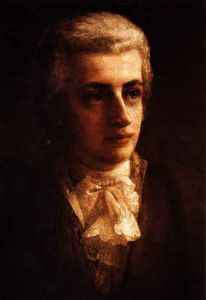
Johannes Brahms, in 1879
To this remarkable pianist, Brahms would send a couple of short piano works composed during a stay in Pörtschach in the summer of 1879. As soon as he finished them, he sent the manuscript to Elisabeth, who in an encouraging letter by return mail recommended a new and fairer title for them: Rhapsodies should be called Rhapsodies and not simply Klavierstücke (piano pieces) as Brahms had titled them.
If it was difficult to talk to Elisabeth, it was even more difficult to contradict her, so despite not being fully convinced of the change the author did not disregard her advice, and so they were published the following year: Two Rhapsodies for piano, opus 79, dedicated, as could be foreseen, to Elisabeth von Herzogenberg.
Rhapsody No 2
Both pieces, in one movement, are composed in the form of a mini-sonata. Presented here is Rhapsody No. 2, in G minor, marked Molto passionato, ma non troppo allegro, Elisabeth's favorite, as she herself told Brahms.
The performance is by the German pianist Ragna Schirmer.
By 1838 Chopin had been settled in Paris for seven years and was already a celebrity among the Parisian aristocracy and the exiled Polish nobility. On February 25 of that year, he was invited to play at the Tuileries Palace for the delight of King Louis-Philippe and his court. Frédéric did not attend very willingly, as the king was not his devotee, but Louis-Philippe was delighted with the evening and repaid Chopin's effort with a personal gift. Three weeks later he appeared twice before a large audience, in Rouen and Paris. In Rouen, the performance of his Concerto in E minor earned him a laudatory commentary in the Gazette Musicale, which ends with the following words:
"... And if from now on it is still asked who is the greatest pianist in the world, greater than Thalberg and Liszt, those who heard you will answer to the whole world: Chopin!"
The year 1838 is the year of Chopin's departure for Majorca, the ill-fated trip he made with George Sand and her children, in October of that year. But before embarking on the voyage he would send for publication the four mazurkas of opus 33 and the three waltzes of opus 34. By that stage of his life, at the age of 28, Chopin had written, but not published, eight of his fourteen waltzes.
The Opus 34
The waltzes of opus 34, released by their publisher as Three Brilliant Waltzes, moved Robert Schumann to refer to them as "waltzes for souls, rather than for bodies", which today may seem a truism since Chopin's waltzes were never written to be danced, this being said with the utmost respect for the good-natured Schumann.
Waltz No. 3 in F major Opus 34 is made up of the Brilliant Waltz No. 1 in A flat major (the only "brilliant" one in our opinion), Waltz No. 2 in A minor (Chopin's favorite according to connoisseurs, and which the film The Pianist featured on its soundtrack), and the one presented here, Waltz No. 3 in F major, just over two minutes long, and nicknamed by some, somewhat syrupily, as the waltz "of the cat" because of the notes of the opening passage that could well illustrate the tricks that such a pet usually does for the amusement of his master.
The outstanding performance is by the Korean pianist Seong Jin Cho.
Franz Liszt's commitment to composing a cycle of twelve studies for piano took him a long time, about 26 years. It is true that he began quite young since his first approach dates from the time when he had as a pupil the Countess Carolyne de Saint-Cricq, his first and failed love. Liszt was then 15 years old, and decided to imitate the serial studies that were common in those days. In them, despite their simplicity, we can see the seed of his later production.
A second version A revision of the original twelve etudes dates from 1837. Liszt was at the height of his fame as a piano virtuoso, and as such, the pieces show a significant intensification of technical difficulties, to the extent that his colleague Robert Schumann noted that only a handful of pianists would be able to perform them in a satisfactory manner.
A third version The third and last version was published in Paris as Études d'Exécution Transcendante, in 1852, and dedicated to his teacher Carl Czerny. Perhaps moved by Schumann's perception, in this version the maestro decided to lighten the virtuosic demands a little, freeing the Études from the excessive pyrotechnics of the 1837 version, and adding, to his advantage, more musical values. This is the version that is performed today and, of course, the twelve pieces continue to be an enormous challenge for the performers.
Franz Liszt (1811 - 1886)
Étude No. 4 in D minor, "Mazeppa" Étude No. 4, one of the most demanding, is inspired by a poem by Victor Hugo, Mazeppa. The poem tells the story of Ivan Mazeppa, a Cossack nobleman who seduces a noblewoman, also noble, but Polish. As punishment, he is tied naked to a wild horse that takes him to Ukraine, where he miraculously arrives alive. After being freed by his Cossack peers, he is named their monarch, in recognition of such a feat.
The work, which attempts to musically reflect the horse's unbridled gallop and the ensuing suffering of the daring Mazeppa, adds to its technical demands an unusual fingering proposed by Liszt, with the pointed purpose of achieving either the required staccato or precise legato. Later, in 1851, Liszt will recreate the story again, with the same title, but this time as part of his cycle of thirteen tone poems, composed during his stay in Weimar.
The rendition is by the brilliant French pianist Emmanuel Despax.
Johann Sebastian Bach, the father of harmony, was primarily a church musician, who was aware that church music was primarily vocal music. That is why his oeuvre is punctuated by compositions to be sung, even when he was primarily concerned with the orchestra or solo instruments. From 1723 on, after being appointed Kantor in Leipzig, his dedication to ecclesiastical music became more intense, since his main responsibility was to compose the music to be sung in the divine offices.
The Passions Cantatas were Bach's daily bread and butter. Not so the Passions, conceived as long works on biblical themes, told the story of Christ's crucifixion according to the gospels and were sung only on Good Friday, in the Lutheran tradition. In the Passions, the historical characters and the evangelist (who leads the narration) are performed by soloists, and the flow of the story rests on recitatives, arias, and choral parts.
Passion according to St. Matthew
As far as we know, Bach would have composed at least five Passions, of which only two are preserved, the Passion according to St. John and the Passion according to St. Matthew. The latter, probably composed in 1729, was first performed on Good Friday of that year in the Thomasschule Church in Leipzig under Bach's baton.
The work, whose text is mainly based on chapters 26 and 27 of the Gospel of Matthew, is written for solo voices, a double orchestra, and two choirs, the latter intended to carry the voice of the believers, on the one hand, and those who ask for blood, on the other, each accompanied by its own orchestral group, hence the "double orchestra".
The oblivion, and Mendelssohn
Like almost all of Bach's works, the St. Matthew Passion fell into oblivion after its author's death in 1750. It was not until 1829 that it was heard again, thanks to a very young Felix Mendelssohn who brought it to the stage in Berlin in an abridged version. Its representation encouraged the interest in knowing the complete work of the father of modern music.
The great final chorus
In our days, Martin Scorsese's film Casino (1995) made an important contribution in favor of the ordinary public by including in the opening credits and in the final scene, the great chorus with which the play ends. It is the cry of the believers before the tomb of the dead Christ: Wir setzen uns mit Tränen nieder ("We prostrate ourselves weeping"), one of the most moving fragments of the work, and whose texts belong to the German poet and librettist Chrystian Friedrich Henrici, also known as Picander.
The performance is by the orchestra and choirs of the Belgian group Collegium Vocale Gent, conducted by Philippe Herreweghe, its founder.
Among the countless myths surrounding Mozart's death, the one that refers to Death itself visiting him to ask him to write his own Requiem stands out. The remaining half-truths, encouraged in our time by the film Amadeus, took shape again for a while: the poisoning by Salieri's hidden hand; the mass grave that turned out to be a shared grave; the absence of his wife Constance at the funeral, a custom of the time; the storm at the burial although that day was clear and bright; and finally, that he died bankrupt... the closest thing to the truth because at the time of his death Mozart had spent the last years robbing Peter to pay Paul.
The classical myth Now, the classical myth, that of the visit of Death, has some substance, for the mysterious emissary sent to the Mozart home by Count Franz von Walsegg could not hide his sinister appearance because of his cadaverous features. The count, an amateur musician who habitually solicited works from professional musicians to pass them off as his own, had been bereaved of his young wife of twenty years in February 1791. In mid-July, he commissioned his not very handsome secretary to ask Mozart to compose a Requiem Mass, taking care not to give any information about the principal. The person himself was also not identified.
The last days, working hard Around the same time, Mozart was commissioned to write an opera to celebrate the coronation of Leopold II as king of Bohemia. The work was called La Clemenza di Tito, whose premiere he conducted in Prague on September 6. At the end of that month, he completed the revisions of The Magic Flute, and in early October he did the same with the Clarinet Concerto. So it was only from the second week of October onwards that Mozart could focus on writing the Requiem, on which he worked until November 20, when he fell into bed and never got up again.
Franz Xaver Süsmayr (1766 - 1803)
The incomplete task Mozart passed away in the early morning of December 5, without having completed the assignment. But the commitment to the unknown client had to be fulfilled, so Constance sent the manuscripts to Joseph Eybler, Mozart's faithful friend, who returned them after recognizing his inability to continue with the genius's task. Finally, it was Franz Xaver Süsmayr, Mozart's disciple, who completed the work in March 1792. Surprisingly, Count von Walsegg only received the finished work in early December 1793, more than two years after he had commissioned it.
Requiem Mass
The Requiem, or requiem mass (rest mass), or mass for the dead, of the Catholic liturgy, is a votive mass, meaning a mass offered by vow on a specific occasion independent of the liturgical calendar. The texts, in Latin, of its sung parts are predetermined, and its development traditionally contemplates the following sections: Introitus / Kyrie Eleison / Graduale / Tract / Sequentia (which, due to the text's length taken from the 13th-century hymn Dies Irae, some composers divide into several movements, including the passage known as Lacrimosa) / Offertorium / Sanctus / Agnus dei (Lamb of God) / Communio.
Requiem for soloists, choir, and orchestra, in D minor, K. 626 Mozart's Requiem contains five sections, each topped by a fugue: 1 Introitus - Requiem / Kyrie 2 Sequentia (Dies Irae, Tuba mirum, Rex tremendae, Recordare, Confutatis, Lacrimosa) 3 Offertorium 4 Sanctus 5 Agnus Dei
Süsmayr's contribution What is Mozart's and what is Süssmayr's in the famous Requiem is still under discussion. But the autograph manuscript preserved in the Austrian National Library shows unquestionably the complete Introitus orchestrated by Mozart's hand, as well as detailed sketches of the Kyrie, and the Sequentia completed up to the first eight bars of the Lacrimosa, plus the Offertorium. Süsmayr himself claimed as his own authorship only the Sanctus and Agnus Dei.
Lacrimosa
In a rendition by the Berliner Philharmoniker conducted by Claudio Abbado, we present here the last movement of the Sequentia, Lacrimosa, which is only 3 minutes long (the complete work lasts about 55 minutes, depending on the version).