Páginas

Monday, September 5, 2022

Scriabin, Prelude for the left hand


The piano and the left hand
Piano works written for the left hand alone are not few. Nor are they plentiful. But among this no lesser number, there are pieces belonging to outstanding composers of almost all times. Most of them, however, are rewritings due to the request of some momentarily crippled pianist or recreated with the purpose of serving as a gigantic exercise for the less skilled hand of an ambidextrous musician.

Wittgenstein
But there are also original pieces commissioned by a pianist crippled forever; this is the case of the Austrian pianist Paul Wittgenstein, who lost his right arm in the First World War, and who received the collaboration of Richard Strauss, Prokofiev, Hindemith and, of course, Ravel (Concerto in D major), thus managing to form, order after order, a new handful of magnificent works just for the left hand.

Brahms
In the previous century, Johannes Brahms gave Clara Schumann an arrangement for the left hand of Bach's Chaconne in D minor so that the pianist would not fall into depression after suffering a minor right hand accident which, in the end, did not become serious.

Godowski
And between the 19th and 20th centuries, the Polish pianist Leopold Godowski (1870 - 1935) stands out, possessing an extraordinary technique that allowed him to rewrite no more and no less than several of Chopin's Etudes for the solo left hand, moving both by a didactic zeal and by the desire to show the world what dimensions his own technique encompassed.

Scriabin
Around the same time, the Russian composer Alexander Scriabin (1872 - 1915) wrote, albeit for his own delectation and enjoyment, a Prelude and a Nocturne, both deeply romantic, as a result of an ailment of the right arm during his adolescence, following his hard work with Liszt's most fierce pieces. Both pieces make up his Opus 9, from 1894.

In a rendition by the extraordinary Chinese pianist Yuja Wang, the less than three minutes Prelude is presented here.

Sunday, September 4, 2022

Mozart, Fantasia in D minor


In 1782 Mozart had only been in Vienna for a year, and at the age of twenty-six, he had established himself there as an outstanding piano player and opera composer of some renown. In December of the previous year, he had participated in a "competition" with his colleague Muzio Clementi, which Joseph II, promoter of the candid duel, declared a "draw". Before July 1982 he had completed the opera The Abduction from the Seraglio, inaugurating with it the genre known as singspiel, the German opera sung in German, which earned him all the applause. That same year he married Constanze Weber in August. Also in 1782, he would have probably composed the delightful piano work that every pianist has had to deal with in his early years of training.


Fantasia in D minor, K. 397
The original manuscript of the work has been lost, and since Mozart had not yet begun the useful recording of his own works (which he would begin in 1784), scholars have had no choice but to speculate about the date of composition. Some date the little work around 1782, others are more precise and date it between August and September of that year.
But perhaps the most curious thing is that the work as we know it today does not belong entirely to Mozart, which opens the door to other speculations.

A small unfinished work
One of the prevailing theories holds that the work may have been intended to be part of another sonata, in D major, probably the sonata K. 311 (from 1777-78), abandoned after Mozart found another solution, and therefore much earlier. What is certain is that Mozart left the work unfinished, although today we can hear it "complete" thanks to the collaboration of a composer who "finished" it by adding the ten final bars, a work probably done by the German composer and organist August E. Müller (1767-1817).

A seven-minute Fantasia
As its title indicates, the little piano piece of just over seven minutes in length exhibits an air of improvisation that makes it difficult to characterize it in any recognizable traditional form other than... fantasia.
The finale, contributed by Müller, has not been to the liking of some musicologists who have labeled it "un-Mozartinian." To us, it seems faultless. His valued collaboration begins at about minute 6:02.

The performance is by the Russian pianist Emil Gilels.

Saturday, September 3, 2022

Wagner, "Ride of the Valkyries"


Composition of the tetralogy "The Ring of the Nibelung", a cycle of four epic operas based on episodes of Germanic mythology, took Richard Wagner no less than twenty-six years. The work of a lifetime was begun in Dresden, in 1848, when the author was flirting with anarchism, and completed in 1874 in the peace and serenity of Wahnfried, the neoclassical villa he had built in Bayreuth, kindly sponsored by his most conspicuous admirer, the esoteric young King Ludwig II of Bavaria.

"The Valkyrie", composed between 1854 and 1856, is the second opera in the cycle. (It is preceded by the introductory drama The Rheingold, and is followed by Siegfried and Twilight of the Gods.) And the famous "Ride of the Valkyries" is the piece that opens the third act, accompanying the Valkyries (daughters of the god Wotan, beautiful warriors, and virgins as well) who, singing their war cry, are preparing to carry out the transfer of the fallen combatants to Walhalla, a majestic hall where the unfortunate heroes end up, hand in hand with the aforementioned virgin warriors.

The so-called The Ride... is the name by which the piece has become popular, and it is so called in its purely instrumental performances, which are usually half the length of the operatic version. But Wagner never titled any section or part of The Valkyrie by that name. So much so, that in her diary, Cosima Wagner registers her annoyance at the letters she received requesting separate performances of The Ride. "I don't know what they are talking about," she wrote.


Disregarding its use in German war newsreels, accompanying Luftwaffe bombing scenes, the piece was enthroned in popular culture through Francis Ford Coppola's film Apocalypse Now (1979), this time accompanying the helicopter attack on a Vietnamese village, as part of the plot. In both cases, the work ended up saluting defeat.

The performance presented here (with the voices of the eight Valkyries) was part of the performance of the complete cycle of the tetralogy, in 2010 and 2012, in a gigantic production by the Metropolitan Opera House in New York. It lasts little more than 6 minutes.

Friday, September 2, 2022

J.S. Bach, Toccata and Fugue in D Minor


Were it not for Johann Sebastian Bach, the musical term "fugue" would be known to only a handful of people. However, the short piece known as Toccata and Fugue in D minor, sometimes simply called "fugue in D minor" belongs to the cultural heritage of half the world. The piece is the master of harmony's best-known work and is perhaps the most famous "fugue" of all the fugues that have ever been, even though it is written for organ, an instrument that many of us have never even come close to seeing.

A youth work
It is a work of his youth and belongs to the "free forms" for organs of that period, which include fantasias, various compositions, and solo fugues without a corresponding prelude (or, toccata, a term after the baroque era).
It was presumably composed during the first years of his stay in Weimar (1708 - 1717) or, even earlier, while he was an organist in Arnstadt (1703 - 1707). That is, at the time of its creation Bach may have been under twenty years old, or at the most, in his early twenties.

Toccata and Fugue in D Minor, BWV 565
The work was published only in 1833 thanks to the efforts of Felix Mendelssohn. Like so many other pieces by different authors, its popularity in the last seventy years is due to its inclusion in the soundtrack of the 1940 film Fantasia.

J.S. Bach (1685 - 1750), in 1715
The piece, highly dramatic and majestic, has two typical sections. The toccata is a free introduction (hence the original name, prelude) built on the basis of rapid scales and arpeggios. And the fugue, like all fugues, interweaves and overlaps repetitions of a main theme weaving a complex interplay of voices, four in this case.

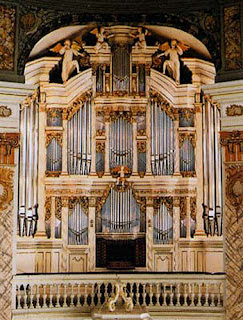
The performance is by the German composer and organist Hans-André Stamm, playing the Trost organ (built between 1724-30 by Tobias Heinrich Gottfried Trost) of the Stadtkirche, in Walterhausen, Germany, with whose image we head this article.

Thursday, September 1, 2022

A. Salieri: Concerto for flute and oboe


At the age of 16, the Italian composer Antonio Salieri was "discovered" in Venice by Florian L. Gassman, then court composer at the court of Vienna. Pleasantly impressed by his talent, he promptly took him to the Austrian capital to give him composition lessons and, incidentally, introduce him to the court of Joseph II.
Two years later, in 1768, Salieri composed his first opera, La Vestale, perhaps not a great success and now lost. The deserved recognition would come later with his opera Armida, of 1771, a great success, which survives to this day, and which had the virtue of making him, from then on, one of the most important opera composers of the time.

Instrumental music
But Salieri did not only write music for the stage. The composer has an important but modest catalog of purely instrumental music, somewhat forgotten today (with the exception, perhaps, of his Piano Concerto in C major), although much of it remained unpublished for many years. This is the case of the Concerto for flute, oboe, and orchestra in C major, written in 1774 and published only in the 60s of the last century, to the disgrace and regret of every oboist or flutist who has passed through this world since the last quarter of the eighteenth century.

Antonio Salieri (1750 - 1825)
Kapellmeister in Vienna
The work was composed at the age of 24, after the composer took up the post of Kapellmeister at the Italian Opera in Vienna, following the death of his mentor Gassman. Thus, the young Salieri held at an early age a position for which Mozart, six years younger, would perhaps have given his life, around the same time.

In Salieri's defense
Let us note here that Constanza Mozart, wife of the genius par excellence, took Salieri as a teacher for her son Franz Xavier, after the death of the genius. Furthermore, that year, in 1791, Mozart and Salieri attended together at least once to see The Magic Flute performed.

Concerto for flute, oboe, and orchestra in C major
Accompanied by the Chernihiv Philharmonic Orchestra, conducted by the Ukrainian maestro Nikolai Sukach, Alexander Popov (flute), and Artyom Alekseenko (oboe), perform the work.

Movements:
The usual ones of the baroque concerto:
00       Allegro
08:38  Largo
16:16  Allegretto