Páginas

Wednesday, November 23, 2022

Beethoven, Symphony No. 1 in C major


Beethoven composed his first symphony at the age of 30, an age at which Mozart had composed most (around 33) of his 41 symphonies. Schubert himself, too, died at the age of 31, leaving a very respectable collection of nine symphonies. What sets the distances apart is that what the Bonn master was about to accomplish in the genre was monumental. In the First Symphony (also in the second) his writing will still be marked by the classical aesthetics of the end of the century, but with it comes a new air that will hatch four years later with the Third Symphony, called Eroica. From then on, there will be no parallel.
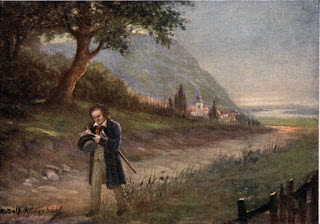

But there is no need to dramatize it either. It has often been insisted on the particular beginning of the Symphony in C major -giving it the character of revolutionary boldness, or premonition-, because it opens in a key other than the tonic. Indeed, the introductory adagio begins in F instead of C major (more precisely, the work opens with a seventh of C that immediately resolves in F). But this being a characteristic of Haydn's late works, we believe that the purpose of its application by Beethoven responds more to a sort of homage to the master, to his master, whom he revered, rather than to any other revolutionary motive.

Symphony No. 1 in C major, op 21
The work was composed in Vienna, between 1799-1800, and premiered at the Burgtheater on April 2, 1800. Beethoven had already written his first two piano concertos and a couple of cantatas, but the master is known more as a virtuoso pianist than as a composer. This, his first symphony, is the work that will point the way toward the composition of the great purely orchestral works.
And he does it in the midst of pain. The pain that arises when he learns that his growing deafness may not be cured. This is what he tells in a letter to his friend Karl Amenda in June 1800, two months after the premiere:
"...You must know that one of my most precious faculties, that of hearing, is become very defective; even while you were still with me I felt indications of this, though I said nothing; but it is now much worse. Whether I shall ever be cured remains yet to be seen; it is supposed to proceed from the state of my digestive organs, but I am almost entirely recovered in that respect. [...] I hope indeed that my hearing may improve, but I scarcely think so, for attacks of this kind are the most incurable of all. [...] I beg you will keep the fact of my deafness a profound secret, and not confide it to any human being. Write to me frequently; your letters, however short, console and cheer me; so I shall soon hope to hear from you."

Movements:
00
        Adagio molto. Allegro con brio
10:33  Andante cantabile con moto.
17:07  Menuetto - Allegro molto e vivace
20:33  Finale - Adagio, allegro molto e vivace

The performance is by the West-Eastern Divan Orchestra conducted by Daniel Barenboim, from the Royal Albert Hall in London (BBC - Proms 2012).

Tuesday, November 22, 2022

Schoenberg, Three Piano pieces, Op 11


Over the course of a little more than twenty years, Arnold Schoenberg, creator of dodecaphonism, composed five sets of pieces for solo piano. These reflect his evolution from an initial break with the harmonic and melodic canons dominating for 300 years, through a return to a kind of neoclassicism, to finally openly address the most rigorous atonality in his last works for piano. Three Piano Pieces from Opus 11 is the first work of his piano production, composed in 1909 and premiered in Vienna the following year.


Schoenberg, musician, and painter
The period leading up to his creation was an embarrassing and unhappy one for the composer. As is well known, Arnold Schoenberg was also a painter (and an outstanding one at that), a vocation that ran almost parallel to that of a musician. In those years he met the Austrian painter Richard Gerstl, whom he took into his home to receive painting lessons from him. It was not a good idea. Gerstl and Mathilde, Arnold's wife, fell in love. Mathilde fled with her painter but returned soon after. Arnold caught his breath, but Gerstl could not stand the pain and killed himself.

The novel twist
Arnold Schoenberg (1874 - 1951)
Portrait by Richard Gerstl (1883 - 1908)
Mathilde returned in October 1908. In February of the following year, Schoenberg began the composition of the Three Pieces. And for the first time in music history, each sound or interval here showed a singular and independent value, free from the hierarchies of tonal discourse. Despite the novel twist, for Schoenberg, it was only the appropriate, obligatory path in the natural evolution of musical language. And so he pointed out in November 1909:
"I am striving to reach a goal that seems to be clear and I already feel the opposition that I will have to overcome.... It is not lack of inventiveness or technical ability, or ignorance of the demands of contemporary aesthetics that has led me to this.... [simply] I am following an inner compulsion that is stronger than education, stronger than my artistic training..."
Going a little further, it is said that Arnold looked forward to a time when grocers' boys would whistle serial music in their rounds. But, sadly for him, this never occurred.

Three Piano Pieces Opus 11 
00       No 1  Mässige (moderato)
03:20  No 2  Mässige (moderato)
09:47  No 3  Bewegte (movido)

The performance, brilliant, is by the Chinese pianist Di Wu.

Monday, November 21, 2022

Mozart, Piano Concerto No 17


Having settled in Vienna in 1781 and married the following year, Mozart had to support the family economy with his talent as a performer and composer. During those years he would compose one piano concerto after the other, the premiere of which was scheduled for a couple of weeks later. As soon as the composition was finished, an orchestra had to be hired, a theater had to be rented (or some similar venue) and the concert had to be sold by subscription. Once all this was organized to perfection, Wolfgang would sit at the piano and conduct on the day of the premiere. That was the rule in general, but there were exceptions.


Concertos on request
Concerto No. 17 in G major was requested by a pupil. Her parents hired the orchestra and the premiere took place at home, in an elegant suburb of Vienna, with the pupil at the piano and Mozart conducting, suitably rewarded. It was not the first time. Two months earlier, Concerto No. 14 had inaugurated this new form of "marketing" to the same interested parties.
On the occasion of the premiere of the Concerto in G major, Giovanni Paisiello was present, invited by Mozart to listen to his pupil and appreciate his progress. The evening ended with the master and pupil playing together four hands.

Concerto for piano and orchestra No. 17 in G major, K. 453
Thanks to the catalog of his works that Mozart began to keep in February 1784, we know for sure that the work was finished on April 12 of that year. In those days (exactly on May 27) Wolfgang bought a pet, with wings, a little bird, a starling.
The starling is said to be a songbird with a great ability to imitate, and it is reported that Mozart decided to buy it after finding that the little bird was able to sing the theme of the third movement. The starling did it wonderfully, except that he always sang a natural G as a G-sharp.

The critics of the time
The concerto is one of the few published during Mozart's lifetime. The critics praised the elegance of the Andante, and the beautiful modulations of the Allegretto, but warned about some somewhat dense passages that would make it difficult to be heard by the common public. These were, perhaps, the beginnings of the period of decline of the Viennese audience's taste for the maestro's piano concertos.

Movements
They are the traditional three ones, in the usual sequence, fast-slow-fast:
00:00   Allegro - Mozart's characteristic opening movement: the orchestra presents the thematic material that will later be taken up by the piano, bringing in new ideas and variations.
13:33   Andante  - Ten minutes of Mozartian elegance.
24:50   Allegretto / Finale: Presto - Theme and variations on the starling's song.

The rendition is by the brilliant Hungarian pianist Dezső Ránki, accompanied by the English Chamber Orchestra, conducted by maestro Jeffrey Tate.

Sunday, November 20, 2022

Schubert, "Wanderer" Fantasy


During his short life span of just 31 years, Franz Schubert wrote an amount of 23 piano compositions that follow the sonata musical form, although only twelve of them were properly finished due to little Franz's tendency to procrastination, i.e., his propensity to delay everything, for one reason or another.
He also wrote eight "fantasias", of which the one popularly called "Wanderer" is, in our opinion, a full-fledged sonata, except for the name. Little inclined to instrumental pyrotechnics, it is nevertheless one of his most technically demanding piano pieces.


The publishing indifference
Composed in 1822, the work did not enjoy great recognition after its publication, as was usual for the author for a long time. It is known that publishers published his works with some reluctance, under the modality "on commission", quite meager, by the way. Therefore, it is not surprising to hear some scholars say that Schubert may have dedicated the Fantasia to a wealthy pupil of Hummel with the veiled intention of being financially rewarded.
Nevertheless, at the time. the author was only twenty-five years old and was enjoying life in the company of his musician, poet, and painter friends. These were the good years of the famous "schubertiades".

Fantasia for piano in C major, opus 15, called "Wanderer" - Sections:
Its four movements, or sections, are played without interruption, each beginning with a variant of the primordial motif, the opening phrase of the lied "Der Wanderer," composed by Schubert seven years earlier, and from which the popular nickname derives. This characteristic also makes it possible to conceive of the work as a sonata written in the form of a theme and variations.

00       Allegro con fuoco
06:32  Adagio
13:39  Presto
18:50  Allegro

The performance is by the Romanian pianist Herbert Schuch.

Saturday, November 19, 2022

Chopin, Piano Sonata No 3


On February 21, 1842, Chopin gave in Paris one of his last recitals. As was still the custom, he accompanied a couple of friends, one a singer and the other a cellist, to finish with a selection of his own pieces. He still had seven years to live but his health showed clear signs of irreparable deterioration. Two years later, with great effort, he accompanied his young friend, Georges Valentin Alkan, to present a version for two pianos and eight hands of Beethoven's Seventh Symphony.

But these were supreme efforts. And naturally, also the production of music had begun to diminish. Let us just note that in 1848 he wrote only one waltz (in B major, without opus number). Only once in the past had he had a year of such scant creativity: 1844, when from his pen came just one piece, his third and last piano sonata. That year, to his further discouragement, he received the news of his father's death in Warsaw. To his consolation, he received a visit from his sister Ludwika, invited to spend a few days in Nohant courtesy of George Sand.

Sonata No. 3 in B minor, opus 58
Although, as we all know, Chopin was essentially a miniaturist, the writing of his vigorous ballades or scherzos must have developed in him the necessary ability to fully undertake the production of works in a genre generally considered "major", such as the piano sonata. We say this because there are those who maintain that one of the spurs for the composition of his third sonata is due to the need to respond to some criticism received by the novel structure of the previous sonata, the famous "Funeral Sonata".

Similar in structure to the latter (though the funeral march has been replaced by a full, lyrical largo), its movements are:
00        Allegro maestoso
09:40  Scherzo: Molto vivace
12:24  Largo
22:40  Finale: Presto non tanto; Agitato

The rendition, terrific, is by the 1994 Singapore-born pianist Kate Liu during her participation in the 2015 International Chopin Competition in Warsaw.