Páginas

Monday, June 14, 2021

Béla Bártok, Romanian Folk Dances


As his pianist mother once said, the child Béla Bartók could distinguish and repeat the rhythms of the dances she played on the piano when he could no to pronounce a complete phrase. By the time he released the first one, the boy already had in his repertoire a few songs to which he added as many as he continued to grow. Before he was five, his mother understood that the boy should pursue formal piano studies. She was not mistaken, because at the age of eleven Béla Bartók was warmly acclaimed in the Hungarian city of Pozsony where he gave his first recital which included the first work of his own, incidentally.

The composer finished his studies in 1901 at the Royal Academy of Music in Budapest, where he had as a companion his compatriot and future composer Zoltan Kodaly, with whom he began a lifelong friendship.

The song of a nanny
In 1902, while on vacation, Bartók had overheard an eight-year-old girl singing folk songs to entertain the children in her care. Captivated by this music, six years later the composer would travel through Hungary and neighboring countries in the company of Kodaly collecting thousands of old folk songs, in search of the genuine ones that the eight-year-old nanny had unknowingly made known to him.

Béla Bartók (1881 - 1945)
The composer's enchantment with this music lasted for decades. It was difficult to escape from its various intricacies that allowed him alternating between quiet plaintive singing and the most fiercely aggressive rhythms. The complexity and perfection he found in Eastern European folk music would exert a powerful influence on Bártok's musical language in the years to come, just as it had done in the previous century with his compatriot Franz Liszt.

Romanian Folk Dances
Composed in 1915, these are arrangements for seven instrumental melodies that Bartók collected between 1910 and 1912 in Romanian localities. The author choose those that best served his intentions because of their timbral diversity and variety. The melodies are practically those of the original source, which Bartók elaborated scarcely because his intention was none other than their transformation into small miniatures whose duration did not exceed one minute. For it, Bartók took care to indicate in the score the exact duration that each one should have.

The original version is for solo piano, but arrangements for other instruments or ensemble of instruments are numerous. Here it is presented in a version for piano and violin by Hungarian musicians Katika Illenyi and Tamas Bolba. (The miniatures are six in all because the last one contains two themes).

Friday, June 11, 2021

Piazzolla, Le Grand Tango


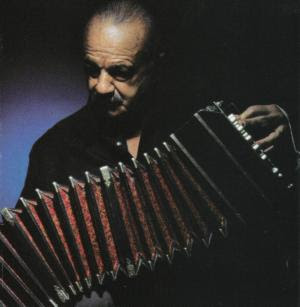
The 1935 film starring Carlos Gardel, "El día que me quieras" ("The day you will love me"), includes a scene in which a boy shows up selling newspapers. The twelve-year-old boy was not an actor. He was a musician. For three years he had been practicing the bandoneon given by his father when he was nine. He did not imagine then that he would become one of the greatest musical figures in South America and an important composer among those who emerged throughout the world in the twentieth century. His name is Astor Piazzolla, born in Mar del Plata, Argentina, in 1921.

The tour it was not
The Piazzolla family had moved from Buenos Aires to New York in 1924 in search of better opportunities. There, Astor's father, also a musician, met Carlos Gardel and made some recordings with him. After the film was finished, Gardel decided to start an ambitious tour of South America and invited the young Piazzolla to accompany him. Fortunately, the boy declined the invitation, and thus saved his life from the accident that took Gardel's life.

Return to the homeland
Astor Piazzolla (1921 - 1990)
In 1936 the family returned to Mar del Plata. From then
until around 1950, Astor Piazzolla joined tango orchestras playing the bandoneon but without abandoning his piano and composition studies.
He began to establish links between tango as a popular dance and his approach to classical music, which his teacher Alberto Ginastera reinforced by making him study Ravel, Bartok, and Stravinski, as well as American jazz.
As a result of all this, his work "Buenos Aires", from 1953,
is to cause a small stir in the musical circles of Buenos Aires due to the use of bandoneon in the symphony orchestra.

Le Grand Tango
The following year, the author of Adiós Nonino won a scholarship to study in Paris with the influential pedagogue Nadia Boulanger. It was she who encouraged Piazzolla to revitalize tango on the basis of the classical and jazz training he had acquired. One of the best examples of the course his music took is the 1982 piece, "Le Grand Tango", premiered by the cellist to whom it was addressed eight years after its composition. Yes, because before that date, Mstislav Rostropovich had never heard of Astor Piazzolla, who, as a bandoneon player in Buenos Aires, had, a little earlier, become the creator of a new genre, the symphonic tango.

The rendition is by Chinese cellist Adam Liu and American pianist David A. Wehr.

Thursday, June 10, 2021

Dukas, The Sorcerer's Apprentice

 
Within the group of so-called minor composers, who have always flourished – just saying – in all styles and at all times, the French composer Paul Dukas is the one who took the cake. Today, he is remembered for only one work that is better known than he himself is. In this withdrawal from the public's favor, it must be said, the composer played an outstanding role: driven by a severe sense of self-criticism, he destroyed a large part of his work, which in his opinion was not worth publishing.

In 1888, at the age of 23, he left the Paris Conservatory – which he had entered six years earlier – after considering it useless to continue trying to win the famous Prix de Rome, which was becoming more and more elusive. However, he was not so far from it because he once won the Second Prize with one of his early works. But around the same time, he had to undergo military service, another reason to leave the Conservatory, compulsory this time.

Paul Dukas (1865 - 1935)
Recognition
After serving his country he returned to civilian life as a composer and critic. A few years later, he was to compose his two best-known orchestral works: the Symphony in C major of 1896 and the symphonic poem The Sorcerer's Apprentice of 1897, gaining with it the recognition of his peers. The latter is a scherzo for orchestra based on a Goethe poem of the same name published a hundred years earlier. Although the work was immediately included in the repertoire of the conductors of the time, its recognition by the ordinary public was greatly favored by its inclusion in the soundtrack of the film Fantasia, shot in 1940, five years after the composer's death.

The Sorcerer's Apprentice
A genuine embodiment of programmatic music, the play faithfully describes each scene of Goethe's original work, where a young apprentice, wishing to imitate his master, an old magician, enchants a broom to perform for him the assigned tasks, among them, carrying water, a situation that gets out of hand when he realizes that he does not know how to stop the enchantment. Only the return of his master will save him from disaster.

The rendition is by the Orchestre Philharmonique de Radio France. After a brief introduction, Dukas uses the bassoon to bring the enchanted broom to life.

Tuesday, June 8, 2021

Mozart, Sonata for violin and piano No 18

 
The second time Wolfgang Amadeus Mozart left his post in Salzburg to try his luck at higher European courts, he did so in the company of his mother, Anna-Maria, even though he was already 21 years old. His father, Leopold, was unable to accompany him on this occasion and, knowing Wolfgang's playful and carefree spirit, thought it advisable that he should not go it alone. What Leopold did not imagine was that the trip would last more than a year and that within that period of time Anna-Maria would fall ill and die in Paris.

The tour
It began on December 27, 1777, and included visits to Munich, Augsburg, Mannheim, and Paris. In Munich, after several successful concerts, he met in a hallway with the Elector just to learn that there were no vacancies. In Augsburg, everyone was amazed at his talent but he was not offered a position. Things appeared to change in Mannheim after making acquaintance with members of the best orchestra in Europe at that time. Some expectations arose but, in the end, it all came to nothing. Only love was fruitful: Wolfgang fell head over heels for Aloysia Weber. He made plans for a future with her, which Leopold instantly thwarted.

Paris
Bowing to his father's authority, Wolfgang left Mannheim for Paris with his mother in March 1778. Not very enthusiastic, they endured Paris and its "sophistication" for four months, until the ungrateful accommodations in cold rooms and the terrible food finally undermined Anna-Maria's health, ending her life on July 3, 1778.

Nannerl, Wolfgang, Anna-Maria
(on the wall) and Leopold, c. 1780
"Palatine" Sonatas
On his return, Wolfgang stopped for a long time at Weber's home in Mannheim, in a second attempt to get a place, again unsuccessful. There he finished composing the sonatas for violin and piano called "palatine" (K. 301 to 306), dedicated to Maria Elisabeth, consort of the Elector of Mannheim, whose territory and dominions were known as the "Electorate of the Palatinate".

Sonata for violin and piano K. 301/293 (N° 18)
The sonata belongs properly to the genre of music of its time intended for domestic enjoyment. With a "gallant" character, it has only two movements:

00   Allegro con spirito   The theme is first introduced by the violin, while the piano accompanies with broken chords. Then, the roles are reversed (0:26). Throughout the movement, the two instruments are in dialogue following this pattern.
8:37   Allegro   Now it is the piano that introduces the theme, which the violin will take up next at 8:47. In its middle section (11:00) it will adopt the minor mode. 12:41: The theme is taken up again in the major mode. The piece concludes with undisguised elegance.

The rendition is by American violinist Hilary Hahn and Beijing-born American pianist Natalie Zhu.

Sunday, June 6, 2021

Chopin, Nocturne opus 15 No 2

 
When Chopin arrived in Paris in September 1831, the city had just under a million inhabitants and its size was a far cry from that of modern Paris. It was a year and a little more since the "three glorious days" of July 1830, which led to Charles X's abdication and the ascension to the throne of the last king of France, Louis-Philippe, putting an end to republican aspirations.
In the autumn of the same year, Henri Délacroix – Chopin's friend in the years to come – painted his famous composition, La Liberté Guidant le Peuple, commemorating the toppling of Charles X –not the French Revolution, as is often believed.

A year later, the atmosphere in the city was still rarefied, and Chopin must have noticed for his first impressions were sweet and sour.

"...Here one finds, all at the same time, the greatest luxury and the worst filth, the highest virtue and the greatest vice..."

At the same time he is pleasantly surprised at the way Parisians behave in the streets:

"What a curious city! All the French prance and chatter, even if they don't have a penny...".

The Parisian salons
That was the open-air atmosphere. In the salons of the decadent aristocracy, of the rising bourgeoisie, also in those salons where Republicans and Saint-simonists (of which George Sand was one of its champions) met, the "romantic" evenings multiplied. Poets, painters, musicians, writers, and singers united their talents in the evenings, to exchange visions of society and the world. It was there that the "poet of the piano" would make his profit, with his veiled touch of preludes and nocturnes.

Nocturne Opus 15 N° 2
Between 1829 and 1846 Chopin wrote 21 nocturnes, 18 of them published during his lifetime and spread over several opuses. Published in 1831, the two nocturnes of opus 15 were dedicated to Ferdinand Hiller, a German pianist contemporary of Frédérick.
The nocturne No. 2 of opus 15 fully represents the structure with which Chopin, from the original proposal of the Irishman John Field – inventor of the genre –, endowed his nocturnes: a ternary structure whose second section must establish a clear contrast with the first:


Thus, obeying the Doppio movimento mark, which tells the performer to double the speed, the piece acquires in its second section (2:00) another "inner" rhythm (five beats against four) with an expressiveness radically different from the first. The third section (2:45) is little more than a re-exposition of the first, slightly modified for the purpose of closing the piece.

The rendition is by the great Cuban-American pianist Jorge Bolet, who died in 1990.