Páginas

Wednesday, June 16, 2021

Jean Sibelius, "Valse Triste"


Born on December 8, 1865, in the provincial town of Hämeenlinna, the most important Finnish composer of all time was christened Johan Julius Christian Sibelius, but at the age of 21, he decided to Frenchify his name. He had recently abandoned his law studies against his family's advice and decided to follow the impulse of his early musical vocation. Betting on the future internationalization of his career, he henceforth went by the name Jean.

Jean Sibelius was quite right. In 1892, his symphonic poem Kullervo gave him a prominent place in the musical scene of his country while warning the world that a new voice was emerging from northern Europe.

Jean Sibelius (1865 - 1957)

Success did not dazzle him, but it gave him enough confidence to decide to start a home. That same year he married Aino, sister of the composer and conductor Armas Järnefelt, who had introduced Sibelius into the family, which also had a son, Arvid, a writer.

Valse Triste, opus 44 n° 1
In 1903, Arvid asked his brother-in-law Jean to compose the incidental music for a play called "Death" (Kuolema). The work, which had a deep psychological resonance (as was to be expected), was premiered in December of that year, together with the six orchestral pieces that Sibelius wrote for it.

The first piece was entitled Tempo de valse lente - Poco risoluto. The following year, Sibelius revised it and premiered it as a brief concert piece under the name Valse Triste. It was an immediate success, to this day.

Nothing better than the opening bars of this piece to confirm the assertion that Sibelius is capable of establishing in a few seconds a sound world entirely his own. After a more lively middle section, a somber ending will close the piece with three mournful chords. It lasts about 

The rendition is by the Estonian Festival Orchestra, conducted by Paavo Järvi.

Tuesday, June 15, 2021

Franz Schubert, "Trout" Quintet


In mid-1818, life seemed to have started smiling for little Franz. That summer he was hired by Count Johann Esterházy, cousin of Haydn's protector, as music tutor to his daughters. The 21-year-old musician moved to the family's country residence in the Hungarian village of Szeliz, an idyllic place where he spent four months teaching singing and piano to thirteen-year-old Caroline and fifteen-year-old Maria. The salary was not bad, and the workload was light. Franz took the opportunity to compose.

The good times
The following year was better, it's perhaps the best year of the composer's life. He gave up teaching at the school run by his father and went to live with friends in Vienna. He had time to compose, read, talk, and enjoy meetings well stocked with beer and wine with his friends. Among them was the famous baritone Josef Vogl, in Schubert's opinion the first singer who had understood him and knew how to interpret him. In the summer of 1819 they both set off for a trip to the town of Steyr, 125 km from Vienna.

The cellist Paumgartner
The small town was bustling with abundant musical activity. Franz and Vogl's performances there – especially of the lied "The Trout" composed in 1817 – attracted the attention of the wealthy businessman and amateur cellist Sylvester Paumgartner, who asked Schubert to compose a major work based on the lied. The result was the Quintet in A major, one of Schubert's most popular works. Completed in Vienna in the autumn of that year, it is dedicated, as expected, to the cellist-entrepreneur.

Piano Quintet in A major, D. 667, "The Trout"
Written for the unusual ensemble of piano, violin, viola, cello and double bass, it comprises five movements: allegro vivace, andante, scherzo, andantino allegreto and allegro giusto. The work uses in its fourth movement the theme of the lied of the same name.

Listening Guide
00:27  Allegro vivace  –  Written in "allegro de sonata" form, after an introduction the main theme is brilliantly presented at 1:13. Development section: 4: 42. Recapitulation: 6:40, initiated by the violin.

10:09
Andante  – Beautifully lyrical, in a minor key. Contains three motives, one of them is given to the solo piano at 12:20; the strings in the role of accompaniment.


18:01  Scherzo: Presto – With an aggressive beginning, and whose momentum does not stop for a moment, it includes several Austrian folk melodies.

22:57
  Andantino - Allegretto – The movement that gives its name to the piece: Theme and variations on the lied "The Trout". The variations are six: Var I: 24:00. Var II: 24:56. Var III: 25:57. Var IV: 26:52. Var V: 27:46. Var VI: 29:11.

30:34
  Allegro giusto – Simple and light. Like the third movement, it seems to contain smaller units in the style of a set of dances.

The rendition is by Natalia Lomeyko (violin), Yuri Zhislin (viola), Juan Cadenas (cello), Andrei Feigin (double bass) and Damián Hernández (piano).

Monday, June 14, 2021

Béla Bártok, Romanian Folk Dances


As his pianist mother once said, the child Béla Bartók could distinguish and repeat the rhythms of the dances she played on the piano when he could no to pronounce a complete phrase. By the time he released the first one, the boy already had in his repertoire a few songs to which he added as many as he continued to grow. Before he was five, his mother understood that the boy should pursue formal piano studies. She was not mistaken, because at the age of eleven Béla Bartók was warmly acclaimed in the Hungarian city of Pozsony where he gave his first recital which included the first work of his own, incidentally.

The composer finished his studies in 1901 at the Royal Academy of Music in Budapest, where he had as a companion his compatriot and future composer Zoltan Kodaly, with whom he began a lifelong friendship.

The song of a nanny
In 1902, while on vacation, Bartók had overheard an eight-year-old girl singing folk songs to entertain the children in her care. Captivated by this music, six years later the composer would travel through Hungary and neighboring countries in the company of Kodaly collecting thousands of old folk songs, in search of the genuine ones that the eight-year-old nanny had unknowingly made known to him.

Béla Bartók (1881 - 1945)
The composer's enchantment with this music lasted for decades. It was difficult to escape from its various intricacies that allowed him alternating between quiet plaintive singing and the most fiercely aggressive rhythms. The complexity and perfection he found in Eastern European folk music would exert a powerful influence on Bártok's musical language in the years to come, just as it had done in the previous century with his compatriot Franz Liszt.

Romanian Folk Dances
Composed in 1915, these are arrangements for seven instrumental melodies that Bartók collected between 1910 and 1912 in Romanian localities. The author choose those that best served his intentions because of their timbral diversity and variety. The melodies are practically those of the original source, which Bartók elaborated scarcely because his intention was none other than their transformation into small miniatures whose duration did not exceed one minute. For it, Bartók took care to indicate in the score the exact duration that each one should have.

The original version is for solo piano, but arrangements for other instruments or ensemble of instruments are numerous. Here it is presented in a version for piano and violin by Hungarian musicians Katika Illenyi and Tamas Bolba. (The miniatures are six in all because the last one contains two themes).

Friday, June 11, 2021

Piazzolla, Le Grand Tango


The 1935 film starring Carlos Gardel, "El día que me quieras" ("The day you will love me"), includes a scene in which a boy shows up selling newspapers. The twelve-year-old boy was not an actor. He was a musician. For three years he had been practicing the bandoneon given by his father when he was nine. He did not imagine then that he would become one of the greatest musical figures in South America and an important composer among those who emerged throughout the world in the twentieth century. His name is Astor Piazzolla, born in Mar del Plata, Argentina, in 1921.

The tour it was not
The Piazzolla family had moved from Buenos Aires to New York in 1924 in search of better opportunities. There, Astor's father, also a musician, met Carlos Gardel and made some recordings with him. After the film was finished, Gardel decided to start an ambitious tour of South America and invited the young Piazzolla to accompany him. Fortunately, the boy declined the invitation, and thus saved his life from the accident that took Gardel's life.

Return to the homeland
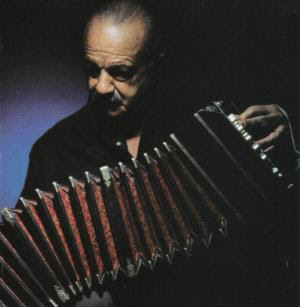
Astor Piazzolla (1921 - 1990)
In 1936 the family returned to Mar del Plata. From then
until around 1950, Astor Piazzolla joined tango orchestras playing the bandoneon but without abandoning his piano and composition studies.
He began to establish links between tango as a popular dance and his approach to classical music, which his teacher Alberto Ginastera reinforced by making him study Ravel, Bartok, and Stravinski, as well as American jazz.
As a result of all this, his work "Buenos Aires", from 1953,
is to cause a small stir in the musical circles of Buenos Aires due to the use of bandoneon in the symphony orchestra.

Le Grand Tango
The following year, the author of Adiós Nonino won a scholarship to study in Paris with the influential pedagogue Nadia Boulanger. It was she who encouraged Piazzolla to revitalize tango on the basis of the classical and jazz training he had acquired. One of the best examples of the course his music took is the 1982 piece, "Le Grand Tango", premiered by the cellist to whom it was addressed eight years after its composition. Yes, because before that date, Mstislav Rostropovich had never heard of Astor Piazzolla, who, as a bandoneon player in Buenos Aires, had, a little earlier, become the creator of a new genre, the symphonic tango.

The rendition is by Chinese cellist Adam Liu and American pianist David A. Wehr.

Thursday, June 10, 2021

Dukas, The Sorcerer's Apprentice

 
Within the group of so-called minor composers, who have always flourished – just saying – in all styles and at all times, the French composer Paul Dukas is the one who took the cake. Today, he is remembered for only one work that is better known than he himself is. In this withdrawal from the public's favor, it must be said, the composer played an outstanding role: driven by a severe sense of self-criticism, he destroyed a large part of his work, which in his opinion was not worth publishing.

In 1888, at the age of 23, he left the Paris Conservatory – which he had entered six years earlier – after considering it useless to continue trying to win the famous Prix de Rome, which was becoming more and more elusive. However, he was not so far from it because he once won the Second Prize with one of his early works. But around the same time, he had to undergo military service, another reason to leave the Conservatory, compulsory this time.

Paul Dukas (1865 - 1935)
Recognition
After serving his country he returned to civilian life as a composer and critic. A few years later, he was to compose his two best-known orchestral works: the Symphony in C major of 1896 and the symphonic poem The Sorcerer's Apprentice of 1897, gaining with it the recognition of his peers. The latter is a scherzo for orchestra based on a Goethe poem of the same name published a hundred years earlier. Although the work was immediately included in the repertoire of the conductors of the time, its recognition by the ordinary public was greatly favored by its inclusion in the soundtrack of the film Fantasia, shot in 1940, five years after the composer's death.

The Sorcerer's Apprentice
A genuine embodiment of programmatic music, the play faithfully describes each scene of Goethe's original work, where a young apprentice, wishing to imitate his master, an old magician, enchants a broom to perform for him the assigned tasks, among them, carrying water, a situation that gets out of hand when he realizes that he does not know how to stop the enchantment. Only the return of his master will save him from disaster.

The rendition is by the Orchestre Philharmonique de Radio France. After a brief introduction, Dukas uses the bassoon to bring the enchanted broom to life.