Páginas

Monday, January 3, 2022

Alexander Borodin, Polovtsian Dances


The fundamental nucleus of Russian nationalism known as "The Five", originated in St. Petersburg in the second half of the 19th century to encourage the creation of properly Russian music, counted among its spirited members a brilliant creator in the person of Modest Mussorgsky, a masterful composer like Rimsky-Korsakov, a great leader like Balakirev, the indispensable theoretician in the person of César Cui, and a doctor in chemistry, Alexander Borodin.

Borodin, the scientist
In fact, Borodin, the illegitimate son of a Russian prince and the legitimate wife of a doctor in his army, – that is, the prince's army –, was a dilettante musician, meaning a musician who made music for the simple pleasure of doing so. Although at the age of nine he had already taken his first flute and piano lessons, and composed his first concerto for these instruments at the age of fourteen, Alexander Borodin soon realized that his true passion was science. In 1850, at the age of 17, he entered the St. Petersburg Medical-Surgical Academy, where he chose chemistry as his special interest.

Borodin, the musician
Around the same time, however, he composed his first songs and formed a string quintet with a group of friends. Nothing strange, then, that three years after obtaining his doctorate with the thesis "About the analogy of arsenic with phosphoric acid", the musician Borodin composed a celebrated Quintet in C major that attracted the attention of The Five, which he joined, later strengthening close bonds with Balakirev and Mussorgsky.

Alexander Borodin (1833 - 1887)
Prince Igor
Around 1869, when he had already composed his first symphony, he felt that the theatrical genre was calling for him and began work on what was to be his masterpiece, the opera Prince Igor. But his scientific career also called for him. As a full professor at the Academy, he had to travel outside Russia often, visiting universities, and even working on joint research with European scientists, which incidentally resulted in the discovery of a couple of chemical reactions that today bear his name, shared.

An unforeseen ending
So Prince Igor had to wait, until 1887 when he was able to take it up again. Unfortunately, on the evening of February 17 of that year, while exercising some dance steps at a costume party organized by the Academy, dressed in the Russian peasant style, he fell to the ground, struck by a heart attack. His most ambitious work had to be finished by his friends Rimsky-Korsakov and Alexander Glazunov. Its premiere took place to great acclaim in November 1890 at the Mariinsky Theater in St. Petersburg.

Polovtsian Dances from Prince Igor
With a libretto by the composer and inspired by a medieval poem, the action of the work is set in the year 1185 and narrates the struggle of Prince Igor against the Polovtsians, an invading tribe. The Polovtsian Dances constitute a brilliant moment in Act II, when Igor, taken prisoner with his son, is offered his freedom in exchange for an alliance that the prince refuses, which arouses the admiration of his enemy, who then commands dances in his honor.

The solidarity group "Músicos para la Paz", performs an orchestral version, conducted by the Spanish maestro Andrés Salado.

Friday, December 31, 2021

Ravel, "La Valse" / Yuja Wang


The first work the Russian impresario Sergéi Diaghilev commissioned to Maurice Ravel, in 1909, suffered many production problems. So, Daphnis et Chloé was not premiered until 1912. With a lukewarm reception at the beginning, it improved substantially with subsequent performances. Diaghilev, who did not agree with Ravel's opinion that the music should be above the choreography, was nevertheless satisfied with the outcome. He insisted on the point when around 1920 he again commissioned Ravel to write the music for a new ballet.

"Vienna"
Since 1906, Ravel had been working on the idea of a waltz that would be a tribute to Strauss and Vienna. The piece, tentatively called "Vienna", was the one that Ravel adapted for the projected ballet but with a clearly different character from the original idea, because by 1920, being the war ended, Ravel had just come from fighting, precisely, to Austria. The elegant gestures of the Viennese waltz then mutated into a painting of a world that had just collapsed.

"La Valse"
This time Diaghilev rejected the work. He said it was "unreachable" and that it did look like a painting, but a painting of a ballet, not a ballet. Ravel was upset and the two artists fell out for good. The work, under the name of La Valse, was later premiered as a concert piece and in 1928 as a "choreographic poem" by the ballets of Ida Rubinstein, for whom Ravel would compose his popular Bolero that same year.

Maurice Ravel (1875 - 1937)
Solo piano version
Maurice Ravel was a brilliant orchestrator, as he demonstrated by transcribing for orchestra numerous pieces originally composed for solo piano, the most outstanding example of which is his transcription of Mussorgsky's Pictures at an Exhibition, today especially known for Ravel's orchestral arrangement.

For this reason, a transcription in the opposite direction, transferring the brilliance and magnificence of the orchestra to piano solo, would seem to be unproductive. However, it is supported by two practical reasons: on the one hand, to allow the enjoyment of the piece on an intimate level, and on the other hand, to supply the need for a score that could be used for the rehearsals of choreographic groups, which is precisely the case of La Valse.
Of course, both purposes meant immediate economic benefits for the composer.

The solo piano transcription of La Valse is far from the grandeur and opulence of the orchestral version, but in Ravel's hands, needless to say, the music has not lost anything, let's just say that it is different, new, and certainly a challenge for the performer.

The rendition, flawless, is by the pianist Yuja Wang, born in Beijing in 1987.

Thursday, December 30, 2021

Strauss Jr, "Die Fledermaus" - Overture


When Die Fledermaus was premiered in the crowded and famous Theater an der Wien, on April 5, 1874, the Viennese citizens were in no mood for celebrations. Although less than a year earlier Vienna had hosted the first World's Fair in a German-speaking region, at the same time the booming capitalism was beginning to experience the first and largest of its recurrent systemic crises, following the collapse of the Vienna Stock Exchange and the immediately subsequent bankruptcy of a powerful banking institution in Philadelphia. The depression, known as the Long Depression, was global in scope and lasted until 1879.


Life on the downside
The economic panic brought down fortunes overnight and hundreds of businesses, including theaters, were affected. As a result, the Viennese bourgeoisie was forced to opt for a rather more austere lifestyle, much to its regret... The Viennese of then, those who in 1850 enjoyed their leisure time drinking in beer halls and cafés and fulfilling the seats of theaters and concert halls, were no longer the same in 1874.

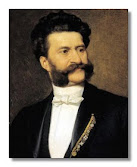
Johann Straus II (1825 - 1899)
Anyway, a success
Despite the adverse conditions, the three-act operetta Die Fledermaus, the most famous of the 16 operettas composed by Johann Strauss Jr, was a remarkable success on the day of its premiere. To this day it remains part of the standard repertoire in its genre, although it is its overture that takes the cake. As an everlasting tribute to the Strauss family, the overture is performed every year for the New Year's Concert in Vienna, ever since the Musikverein began the series of concerts welcoming the new year in the early thirties.

Die Fledermaus - Overture
The 2010 version is presented here, with the Vienna Philharmonic conducted by the French conductor Georges Prêtre. The tune that everyone is able to recognize and which identifies the work can be heard from minute 3:05 onwards.
The Viennese citizens will have been reconciled with life, we presume.

Tuesday, December 28, 2021

Charles Ives, "Unanswered Question"


As far as we know, there is no other composer in the history of Western music who, along with his creative activity, has successfully worked in a profession so far away from the inner life that musical art entails, such as insurance sales. Indeed, the American composer Charles Ives achieved an enviable financial position shortly into his adult life, becoming a respected insurance professional before the age of 35. With his life financially solved, he went on to dabble in music.

Early Years
Born in Danbury, Connecticut, on October 20, 1874, Charles Edward Ives' musical talent quickly revealed itself. At the age of 10 he was playing drums in the band his father directed, at twelve he was a skilled organist at Sunday services at the local Presbyterian church, and by thirteen he had composed his first piece: a sort of requiem in tribute to his dead cat. He entered Yale at the age of 20 and not without effort four years later received his diploma after submitting an interesting if somewhat conventional symphony.

A successful executive
As a graduate working as an organist at the Central Presbyterian Church in New York and facing the difficulties of the job, he realized that he was living in a country where the process of capitalist accumulation and the emergence of new types of property was gaining momentum, while insurance was becoming an increasingly promising activity in the service sector. In 1902 he decided to try his luck. Soon after, he became independent and together with a friend founded the first Life Insurance Mutual in Manhattan.

Charles Ives (1874 - 1954)
Within a few years, Charles Ives had become a successful insurance executive who, while riding the commuter train from his home to his Manhattan offices, would compose music with complete freedom, not caring what the world would think of his work.

"Unanswered Question"
Written for trumpet, winds and string orchestra, the work is one of the two short orchestral pieces that made up the diptych Two Contemplations of 1906, where, according to scholars, the composer's language and musical ideas can already be seen. It is a sort of "nocturnal music" for strings on which a protagonist trumpet stands out, carrying the melodic line, and asking a question, superimposed on an orchestral ensemble to which it does not seem to belong.

Bernstein's opinion
In 1967, Leonard Bernstein gave the following masterful description of the work:

"Ives assigns this question to a solo trumpet who intones it six separate times.
And each time there comes an answer, or an attempt at an answer, from a group of woodwinds. The first answer is very indefinite and slow; the second is faster, the third even faster, and the sixth so fast it comes out like wild gibberish. These woodwinds, according to Ives, represent human answers, growing increasingly impatient and desperate, until they lose their meaning entirely. And all this time, right from the beginning, the strings have been playing their own music, infinitely soft and slow and sustained, never changing, never growing louder or faster, never being affected by that strange question-and-answer dialogue of the trumpet and the woodwinds. It is as though the strings were the great galaxy of stars, which keeps slowly, imperceptibly circling about over our heads, as we ask questions and try to give answers..."

Andrés Orozco-Estrada conducts the Frankfurt Radio Symphony Orchestra.

Thursday, December 23, 2021

Tárrega, "Capricho árabe", for guitar


Francisco Tárrega, the author of the famous tremolo Recuerdos de La Alhambra, suffered an accident in his childhood that seriously damaged his eyes when he was already showing signs of musical talent. His guitarist father, fearing that later on the young boy might lose his sight completely and be crippled for life, decided that his son's profession should be music because, blind and all, it would allow him to earn a living. Going one step further – so that future life would not seem ominous to Francisco – he had him take lessons with two blind teachers, one after the other. After a few years, the pair of blind men had done their job to perfection.


In Barcelona
From then on, a renowned concert guitarist from Barcelona took him under his tutelage, whose teachings made it possible for Francisco Tárrega to enter the Madrid Conservatory at the age of 22 to study composition. He also studied piano, following the advice of his father, who was aware of the guitar's weaknesses as a concert instrument.
But after hearing him play on a stupendous concert guitar, his composition teacher understood the potential that the instrument held in Tárrega's hands, encouraging him to devote all his attention to the guitar and forget about the piano.

The classical guitar
Francisco Tárrega (1852 - 1909)
A very fortunate decision. Francisco Tárrega is today recognized for his immense contribution to the transformation of the classical guitar into a solo instrument and its incorporation into the concert hall. Tárrega's nearly 80 compositions for solo guitar and more than a hundred transcriptions of pieces by classical and romantic composers, mostly originally for piano, contributed to this achievement.
Among the most recognized works of his authorship, besides the popular Recuerdos de La Alhambra, stands out for its grace and charm the little piece Capricho Árabe, from 1880, a candid look at the time when southern Spain was occupied by the Moorish invaders for seven centuries.

The rendition is by the young Belarusian guitarist Tatyana Ryzhkova.