Páginas

Friday, May 6, 2022

Wieniawski, Concerto for Violin No. 2


It is well known that the Polish nation has always had to deal with its voracious neighbors. During the 18th and 19th centuries, for example, it had to cede from time to time a portion of territory to Austria or, failing that, to Prussia, or to suffer, now or later, the intervention of the tsarist army. So, it is not surprising that when the violinist and composer Henryk Wieniawski came into this world in Lublin in 1835, Poland was under Russian domination. Interestingly, Wieniawski saw his career take off and flourish in St. Petersburg, where he eventually became one of the leading musical figures of Tsarist Russia.


A new Paganini?
Coming from a family with a long musical tradition, Wieniawski entered the Paris Conservatory at the age of nine and at eleven received his first prize in violin. A child prodigy, two years later he began a career as a concert pianist. Along with achieving status as one of the greatest violinists of the time - he was often compared to Paganini - the virtuoso also matured as a composer.

Henryk Wieniawski
(1835 - 1880)
The first attempt
A first violin concerto, written at the age of 18, had won over the public but not the critics: a lot of virtuoso playing empty of substance, was the general comment. The critics were right since the work has not reached us.
Different is the case of his second concerto, premiered in St. Petersburg in 1862, conducted by Anton Rubinstein. The highly demanding work remains to this day as one of the great violin concertos of the Romantic era.

Concerto for Violin and Orchestra No. 2 in D minor
It was begun around 1856 and premiered on November 27, 1862, with the composer as soloist. It was published many years later, in 1879, with a dedication to his friend and virtuoso colleague, Pablo de Sarasate.

It is in the three traditional sections, with the second movement joined to the first, without a pause.

00        Allegro moderato
10:37  Andante non tropo (romanza)
15:03  Allegro con fuoco - Allegro moderato (a la zíngara)

The performance is by Korean violinist Bomsori Kim, with the T. Szeligowski Poznań Philharmonic Orchestra conducted by Marek Pijarowski.

Friday, April 29, 2022

Chopin, Berceuse in D flat major


In the summer of 1844, Chopin again spent the season in Nohant, in the company of Mrs. Sand and her children. This time they were joined by Ludwika Chopin, Frédérik's older sister, whom Frédérik had not seen since his departure from Warsaw, 14 years earlier. As usual, they resumed walks and excursions in the region, as well as evenings out, after a day of gratifying work.

The singer Pauline Viardot-Garcia, was unable to attend. She was on tour. On her behalf, she left her little daughter with them, in the care of Mrs. Sand. There is speculation that the little girl may have been the inspiration for the lullaby Chopin began to write that year in Nohant (although it is hard to imagine Frédérik engaged in cuddling with a baby).

The work, completed in 1844, was published the following year with a dedication to a very dear person to Chopin, his pupil and admirer Elise Gavard, who would become great support after his breakup with George Sand in 1847 and who would be present at his deathbed two years later.

Berceuse opus 57 in D flat major
The short and simple piece is the only lullaby that Chopin composed. But it was enough for him to elevate the form to a higher category of art, from which other composers, Liszt among them, took inspiration. The work takes the form of theme and variations, with a melodic line supported by the simplest harmony imaginable: tonic and dominant, a basso obstinato that runs through the whole piece, from beginning to end, entrusted to the left hand. The variations are 14 in number, with increasing difficulty until the middle of the piece and then return to the simplicity of the beginning.

The rendition is by the French pianist Elizabeth Sombart, who after adding a couple of biographical details about Chopin, illustrates on the keyboard the work to be done by the left hand, then shows us the theme and the most complex variation. After this introduction, she begins her excellent performance at 1:50.

Friday, April 22, 2022

Tchaikovsky, Suite from Swan Lake


The most famous ballet in the world was a complete failure for its premiere, on March 4, 1876, at the Bolshoi Theater in Moscow. The circumstances were manifold. Poor choreography, poor scenery and costumes, lousy direction, and numbers considered unattainable replaced by others to please the soloists, finally resulted in the staging of a disastrous production. But Pyotr Ilyich Tchaikovsky did not fall into depression this time. He simply forgot about the ballet, although in 1882 the work returned to the stage with new choreography and some adjustments, which resulted in a better reception.

An attempted orchestral suite
That same year, learning that Léo Delibes had taken to converting his ballets into concert suites, Tchaikovsky asked his publisher, Piotr Jurgenson, to send him a copy of the score. The master was once again interested in the ill-fated ballet with the intention of extracting an orchestral suite from its music and, who knows, perhaps revising the entire work again. But none of this happened. Tchaikovsky died in 1893 without having sent Jurgenson the suite – let alone the revision of the ballet – although it is possible that he had sent one piece or another, but we cannot be sure.

Tchaikovsky in his last days
(1840 - 1893)
A "Jurgenson suite", opus 20a
The only certainty is that Jurgenson published in November 1900 a "suite" made up of six ballet numbers, as opus 20a. Since the authorship of its construction is not clear, the versions heard today of the orchestral suite of the ballet Swan Lake are varied. There are them with six numbers – the "original" –, with eight (adding a Spanish dance, or a Neapolitan, and a mazurka), and also with nine. As if that were not enough, the order in which they are presented is also up to the taste of the performers, or the conductor.

So, there is something for everyone in the Swan Lake Suites. The following version is from the Symphony Orchestra of a music school in Gdansk, Poland, conducted by Sylwia Anna Janiak.

00:26  Scene. Moderato

03:39  Waltz. Tempo di Valse

11:10  Swan Dance. Allegro moderato

12:50  Scene. Andante

19:35  Hungarian Dance. Czardas. Moderato assai.

Wednesday, April 13, 2022

Schumann, Kinderszenen, for piano


In the spring of 1838, 28-year-old Robert Schumann was right in the middle of his eventful and lengthy courtship with Clara Wieck, nine years his junior. Despite her youth, Clara was already a noted and internationally acclaimed pianist who spent much of the year on tour, so the courtship had to be conducted mainly by letter. The last tour, which had begun in October of the previous year, had been going on for five months. It seemed never-ending to Robert, but he filled the waiting period by working hard. In March of that year, he wrote to Clara:

"I have discovered that suspense and longing are the best spurs to the imagination. I have had my full share of these the last few days, as I sat waiting for your letter and writing whole volumes of wonderful, crazy, gay compositions, which will make you open your eyes when you play them. Indeed, I sometimes feel as if I should burst with music. Before I forget, let me tell you what I have written. Whether or no in response to some words you once wrote saying I some times seemed to you like a child, I took flight and amused myself with working out thirty droll little pieces, twelve of which I have selected and christened Kinderszenen. You will like them, though you will have to forget you are a virtuoso for the time being."

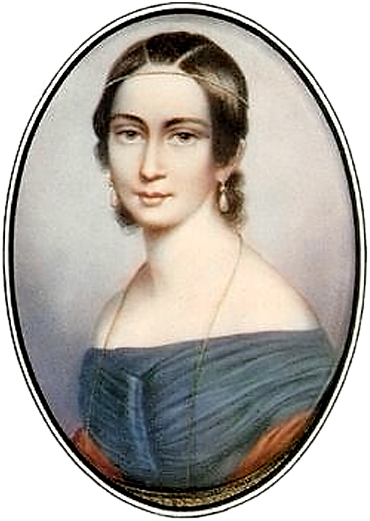
Clara Wieck (1819 - 1896)
Scenes from childhood
Indeed, the small set of miniatures, Kinderszenen, does not pose great technical difficulties to their interpretation, although they were clearly not written for children to exercise with.
Of the 30 pieces referred to, Schumann chose thirteen to integrate this simple "suite" which, according to scholars, constitutes a tribute to childhood memories and feelings from an adult perspective; miniatures that – given Schumann's troubled soul – led a 24-year-old Julio Cortázar to point them out as "a ray of sunshine in the tormented atmosphere of his art".

After the work was finished, Schumann attached to each piece a title, which has no other purpose than to subtly suggest its character to the performer.

With the popular Träumerei as piece N°7, the thirteen scenes are:

00:38 Scene No.1 | Von fremden Ländern und Menschen (Of Foreign Lands and Peoples)

02:09 Scene No.2 | Kuriose Geschichte (A Curious Story)

03:15 Scene No.3 | Hasche-Mann (Blind Man's Bluff)

03:48 Scene No.4 | Bittendes Kind (Pleading Child)

04:38 Scene No.5 | Glückes genug (Happy Enough)

05:17 Scene No.6 | Wichtige Begebenheit (An Important Event)

06:09 Scene No.7 | Träumerei (Dreaming) http://youtu.be/6z82w0l6kwE

08:43 Scene No.8 | Am Kamin (At the Fireside)

10:02 Scene No.9 | Ritter vom Steckenpferd (Knight of the Hobbyhorse)

10:43 Scene No.10 | Fast zu ernst (Almost Too Serious)

12:12 Scene No.11 | Fürchtenmachen (Frightening)

13:52 Scene No.12 | Kind im Einschlummern (Child Falling Asleep)

15:31 Scene No.13 | Der Dichter spricht (The Poet Speaks)

The rendition is by master Vladimir Horovitz, born in Kyiv on 1 October 1903 and died on 5 November 1989 in New York, aged 86.

Thursday, April 7, 2022

Claude Debussy, "Pour le piano"


In 1898 Claude Debussy's economic situation was by no means the most comfortable. Nor was his sentimental life going through a good time. That year he broke up with Gabrielle Dupont, his "green-eyed Gaby", the muse whom he lived with for ten years, although he soon overcame this situation by marrying at the end of 1899 a beautiful brunette, Rosalie Teixir, called Lily in the working environment of her job as a mannequin in a haute couture house.

Monsieur Croche
In order to cope comfortably with this new scenario, he had to accept a "nourishing" job, as he used to call them. Thus, in 1901 he began to write musical chronicles for the art magazine La Revue Blanche, where he invented a somewhat ambiguous and at times irritating character, Monsieur Croche (Mr. Quaver), with whom he would fantastically dialogue, and from whom he took advantage to air what until then he had reserved for his intimate environment:

"...Musicians listen only to music written by dexterous hands; never to that which is inscribed in nature. To see the day being born is more useful than listening to the Pastoral Symphony. Discipline must be sought in freedom. Do not listen to anyone's advice, but only to the passing wind that narrates the history of the world".

These are the words of "Monsieur Croche", taken from a long article of July 1, 1901.
Debussy remained a contributor to the magazine until December of that same year, when the work on his only opera, Pelléas et Mélisande, began to fully involve him.

Pour le piano
Published in 1901, the work is a piano suite in only three movements that Debussy had begun around 1894. A first version of the central movement was already part of his Images inedites of that year, and its final movement was probably composed in 1896. Dedicated to two of his students and to a friend – one movement for each of them – the work, very brief, is a reflection of the definitive transfer of his original musical language to the piano.

Movements:
00        Prelude.  At once familiar and exotic, with reminiscences of Rameau and Javanese gamelan. (I venture to guess that Gershwin paid close attention at minute 1:32).
04:49  Sarabande.  In Debussy's words, a "conversation with the piano," or rather, a conversation with Satie, from whose 1887 sarabandes he borrows something.
09:35  Toccata.  The most solid of the three sections, highly demanding, and simultaneously extroverted and graceful.

The rendition is by Italian pianist and composer Bruno Canino.