In 1871, a 31-year-old Tchaikovsky had been teaching harmony for five years at the Moscow branch of the Russian Musical Society, which would later become the Moscow Conservatory. He had come to that position following an invitation extended by his friend Nicholas Rubinstein, who at the time was serving as director of the school. But the salary was rather meager, and Tchaikovsky was forced to write articles of music criticism to increase his income, thus taking precious time away from composition.
The Quartet No. 1 - Premiere
In these circumstances, five years before the appearance on the scene of Madame von Meck and the six thousand rubles a year that came with her, the young master resolved to stage a concert with his own works and for his own benefit, which took place in March 1871. The concert included the contribution of his friend Rubinstein who accompanied some ladies of the nobility on the piano in a couple of songs, and ended in style with the First Quartet for Strings written by Tchaikovsky, composed just a month before, and which on the occasion was performed by professors of the Russian Musical Society.
Tolstoy and the Andante
The evening was a success, even financially, and constituted an important first step in the composer's career. During the rest of his life, Tchaikovsky would write only two other string quartets, and although according to connoisseurs the third is the best of them all, none is as popular as this one, No. 1, due, especially to its famous second movement, Andante. According the maestro himself recounts in his Diary, it once made Leo Tolstoy weep:
"I believe that never, in all my existence as a musician, have I ever felt so flattered and moved as the moment when Tolstoy, seated next to me, began to sob on hearing my First Quartet."
Quartet No. 1 in D major, opus 11 - Andante cantabile It is in the usual four movements. Presented here is the second, Andante cantabile, in a performance by the Russian Borodin Quartet. It opens with a simple folk melody that Tchaikovsky would have once heard sung by a carpenter. The second theme is original, and is introduced by the first violin, at 2:29. Numerous arrangements for string orchestra and various other instrumental combinations have contributed to the movement's popularity.
By the mid-1930s, well past the age of fifty, Maurice Ravel was one of the great internationally recognized musicians. In 1927 he created his most popular work, Bolero, which, it is said, could be heard in those days whistled and hummed in the streets. In 1928 he toured Canada and the United States on an acclaimed tour, receiving composition commissions and meeting American musicians, among them Gershwin, who asked him to give him lessons. Ravel replied that there was no need. On the contrary, it was Ravel who was captivated by the jazz twists in the music of the author of Rhapsody in Blue.
Oxford That same year he was awarded an honorary doctorate by the University of Oxford. According to Ravel himself, the dazzling initial theme of the Piano Concerto emerged while he was traveling by train from Oxford to London, we don't know if it was on the occasion of the doctorate or some other. By the following year, he had the concerto well underway. He thought of premiering it during a tour planned for that year, but the tour never took place. The composer was already 54 years old and his health had begun to decline.
Maurice Ravel (1875 - 1937)
Piano Concerto in G major The concerto was completed only in November 1931 and was not premiered by Ravel but by the famous French pianist and pedagogue Marguerite Long (to whom it is dedicated), during a legendary concert held on January 14, 1932, with Ravel conducting the Lamoureux Orchestra. The premiere was a great success and a few weeks later Ravel and Long toured nearly twenty European cities, to the applause of all audiences.
Jazzy harmonies and language – which the composer had experienced firsthand on his American tour –, are abundant in the first and third movements, but maintain a strictly "Ravelian" character, in the sense that they do not come across as music brought from elsewhere.
Movements: The work is in three sections, in the traditional fast - slow - fast scheme: 00Allegramente 09:30Adagio assai (at its conclusion, it requires the performer to maintain an interminable trill for more than half a minute) 18:46Presto
The performance is by the incomparable Argentine pianist Martha Argerich, accompanied by the Orchestre National de France conducted by Emmanuel Krivine. The video includes two encores, Kreisler and Scarlatti.
When Johann Sebastian Bach left his position as Kapellmeister at the court of Köthen to assume the position of Kantor at the St. Thomas Church in Leipzig in May 1723, he clearly descended in rank. We say this in a figurative sense, of course, but the fact is that he went from holding the highest rank in the musical organization of the Germany of his time – in a minor court – to that of church Kantor but in a large city. In this last position, apart from composing music and leading performances in the two most important churches of the city, the maestro had to teach Latin, catechism – that of Luther –, and music, to the pupils of the Thomasschule, the public school that depended on the St. Thomas Church.
The Collegium Musicum
Four years later, the situation had become more difficult due, on the one hand, to the bureaucracy of the authorities of the Leipzig City Council and, on the other, to Bach's impetuous and somewhat stubborn character. And the disagreements increased.
Fortunately, in April 1729, he was entrusted with the leadership of one of the many secular musical societies that flourished in Germany during the first half of the 18th century, the Collegium Musicum of Leipzig.
There he had at his disposal a remarkable instrumental ensemble, which was capable of giving one or two concerts every week. For that ensemble, Bach revised and adapted the instrumental music he had composed while in Köthen.
Arrangements for keyboard
With the sole exception of the Flute Concerto in A minor, all the "arrangements" were made for harpsichord and orchestra. They exist for one, two, three, and even four harpsichords, as they were also intended to be performed at home, in the company of his sons Wilhelm Friedemann and Carl Philipp Emanuel, both of whom had become skilled "keyboard players", by the time the arrangements are dated, 1730.
Concerto No. 5 in F minor, BWV 1056
Seven are the adaptations for solo harpsichord. Presented here is the Concerto No. 5 in F minor, structured in the usual three movements: fast - slow - fast. Originally for harpsichord, violins I and II, viola, and continuo, it is offered here in a version for piano and string orchestra by Sven Brajkovic accompanied by the Samobor Strings chamber ensemble.
Movements
00Allegro moderato Like the third movement, it probably comes from a piece for violin, in G minor.
3:39Largo (Arioso) The more popular of the movements. From an oboe concerto. It was also used by Bach in a cantata. Its first measures are quite similar to the Andante from Telemann's G major flute concerto, with some certainty earlier. As was the custom, perhaps Bach wanted to pay homage to his friend Telemann in this way.
6:25Presto Taken from a violin work, as noted above.
The video includes (10:43) the Sarabande from Bach's French suite no. 6 in E- major.
The famous group of Russian nationalist musicians known as The Five, born in the 60s of the 19th century, had creators among its members who were not always exclusively dedicated to music, nor did they turn it into the profession with which they earned their livelihood. Borodin, an expert in aldehydes, never abandoned his profession as a chemist. Rimski-Korsakov was an officer in the Russian Navy, and César Cui was a military engineer. Balakirev combined music studies with engineering, and Mussorgsky, a military man when young, spent most of his life as a ministry official.
On the verge of oblivion
Now, if we make the exercise of bringing to mind the most relevant musicians of the famous group, Rimsky-Korsakov comes to mind, of course, and secondly, Modest Mussorgsky, although the latter was recognized in his time as an interesting author of songs and operas that will not stand the test of time, with the remarkable exception of his masterpiece in the genre, Boris Godunov. Precious hours will have been taken away from Mussorgsky's musical creation by his work as an obscure clerk, for had it not been for the orchestrations of his works made by colleagues after his death, we would perhaps remember him less than César Cui.
Without going any further, his most popular work, A Night on Bald Mountain, from 1867, was orchestrated by his friend Rimsky-Korsakov in 1886, five years after the author's death, gaining only then the popular favor (and it is even said to be an original work by Rimsky based on pages by Mussorgsky that did not reach completion).
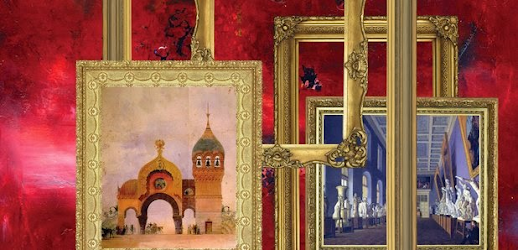
The right guess of Ravel And the case of the piano suite Pictures at an Exhibition, from 1874, is no different (its genesis and description, here). Also published five years after his death, although edited by Rimsky-Korsakov again, it had to wait until 1931 to be published keeping fidelity to the composer's manuscripts. And in spite of being Musorgsky's most finished piano composition and one of the most original creations of Russian romanticism, it only became known to the general public through the orchestral version that Maurice Ravel made of it in 1922. There were many previous attempts, but in the face of the fullness of Ravel's success, these have proved to be "unnecessary", in the opinion of scholars.
Modest Mussorgsky, in 1874 (1839- 1881)
Art and solitude
Modest Mussorgsky did not enjoy a good life. Constantly afflicted by nervous depression and some episodes of epilepsy, he had to face sentimental loneliness, economic hardship, and, at times, the incomprehension of his work by his peers. At the age of forty, Musorgsky was a human being in sorrowful decadence, given in some degree to drink, but even in those conditions, he had the courage to abandon definitively his position as a civil servant and become a modest pianist accompanist in singing schools. From there, sometimes an event would arise, regrettably paid, to accompany at the piano some aspiring diva who was trying to gain an audience.
Posthumous celebrity
Mussorgsky died in a military hospital on March 28, 1881, without ever having known anything close to prestige, or fame. Forty years later, the most formidable orchestrator on record, Maurice Ravel, will provide it, copiously, to keep his name high to this day.
This is the RTVE Symphony Orchestra, conducted by Miguel Ángel Gómez Martínez.
Excluding the long hiatus of almost a year and a half during which he traveled through central Europe with his mother in search of better airs, Wolfgang Amadeus Mozart had to put up with his rude patron, Prince-Archbishop Colloredo, for nine years, from August 1772 to May 1781, when the final break occurred after a harsh debate. From the beginning relations were strained, and from then on they only worsened to the point that the prince-archbishop, during an interview granted to Leopold Mozart in 1777, went so far as to point out to Leopold that his son "knew nothing and what he should do was to go to Naples to learn music at a conservatory".
The six violin concertos Nevertheless, stifled and mistreated by an ungracious patron in the provincial environment of Salzburg, Mozart produced many of his best works there, some of them composed at an astonishing speed. This is the case of the only six violin concertos indebted to Mozart. Today as true masterpieces, No. 3, No. 4, and No. 5 were written in just four months, between September and December 1775, while the vassal Mozart was composing without pause music for religious services and various special occasions.
Concerto for violin and orchestra No. 5, in A major, K. 219 With Concerto No. 5, somewhat crudely called the "Turkish Concerto" (because of the rondo), Mozart managed to create something very much in the line of what the 19th century would come to know as the concerto for solo instrument and orchestra. Although openly framed in the tradition of the "classical" chamber concerto, its long extension -around 25 minutes- and its great technical demand reveal that a new role has been assigned to the violin as a solo instrument. Not a few concertos of similar stature were written at the same time, but none managed to survive the test of time with the gallantry that Mozart's No. 5 has done.
Movements: 00Allegro aperto - Adagio - Allegro aperto - The only instance in Mozart's concerto repertoire in which the soloist makes his first entrance with a brief adagio independent of the orchestral exposition (Allegro aperto: somewhat more majestic than an ordinary allegro).
10:56Adagio - One of Mozart's longest slow movements, with a beautiful passage in the middle section.
21:54Rondo - Tempo di Minuetto - The best-known movement of the work, with an alla turca section, in the prevailing fashion of the time and which Mozart would replicate three years later by introducing a rondo alla turca, the famous "Turkish March", in the piano sonata in A major.
Belarusian violinist Artiom Shishkov is accompanied by the Belgian ensemble Orchestre Royal de Chambre de Wallonie, conducted by the German maestro Michael Hofstetter.